A balcony under 60 square feet demands furniture that folds to under 4 inches deep, or the space becomes a storage closet you cannot walk through.
What separates the balconies that get used from the ones that collect boxes is whether the owner measured the hallway turns before ordering, not the floor plan after.
1. Bistro Sets
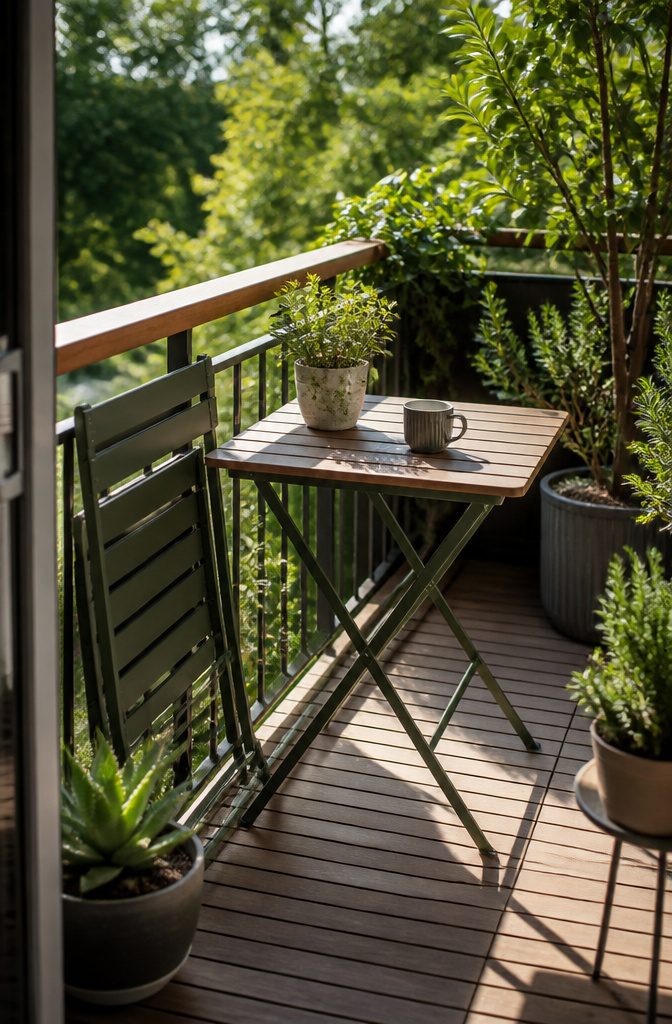
Bistro chairs are built for balconies under 60 square feet, and the ones that fold make the difference between furniture you own and furniture that owns your space.
A powder-coated steel set or one in sustainably harvested teak can shift from morning coffee to open floor in seconds, which matters when your balcony also stores bikes or doubles as a yoga spot.
The dimension that saves you is the folded depth. Most flat-fold bistro chairs stack to about 3–4 inches each; leaned against the railing or slid behind a storage bench, they disappear without leaving the balcony.
The table usually folds too, or drops its leaf if wall-mounted, though that requires drilling into exterior walls your lease may not allow.
I have leaned toward flea market bistro sets with new outdoor fabric cushions because the wear already happened.
Antique heart-shaped chairs or simple cafe tables with some weathering look deliberate, not neglected, and you stop worrying about every raindrop. The new fabric is what makes them usable; the old frame is what makes them forgiving.
If you buy new, skip the chunky lounge profiles that read "backyard" and measure your walking path with the chairs in place.
Leave at least 24 inches clear between the table edge and the railing or wall, or you will sidle around your own furniture every single time you step outside.
2. Vertical Gardening
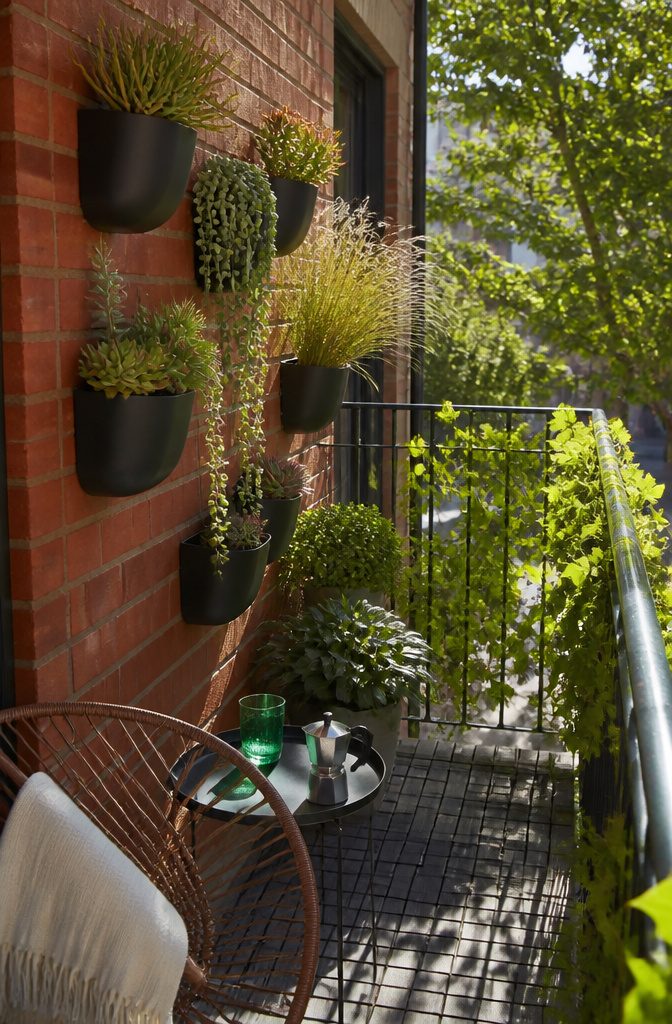
Wall-mounted planters and hanging systems free the floor for the one chair you actually use.
A metal rack screwed to the exterior brick or a set of pocket planters on the rail keeps square footage clear and draws the eye upward, which helps a tight balcony feel less like a ledge and more like a room.
Wind is the part nobody warns you about until a pot tips and spills soil four stories down. Ornamental grasses, succulents, dwarf conifers, and something woody like boxwood hold up to gusts that snap delicate stems.
Heavy ceramic or concrete bases keep containers upright; narrow plastic ones will skate across the tile the first time a front moves through.
Weight limits on balcony walls or railings are not a place to guess. Building management and structural guidelines exist for a reason, especially on cantilevered balconies where the load hangs out past the building’s frame.
A fully saturated pocket planter or a loaded trellis adds up fast, and the failure mode is not a mess in your kitchen but a liability claim.
Check before you drill, and if you cannot get a straight answer, keep the installation light and the soil volume small.
3. Multifunctional Furniture
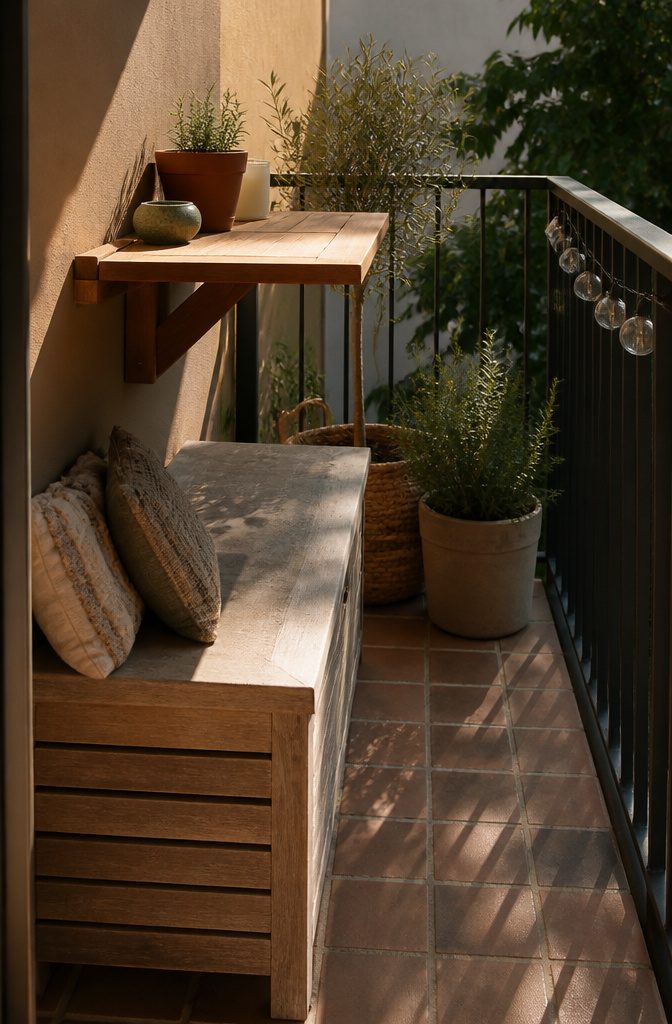
A storage bench was the first piece I seriously considered for my own balcony, mostly because I needed somewhere to hide the cushions that otherwise spent winter in my bathtub.
Sources split on what actually survives inside them. One approach favors weather-resistant performance fabrics with concealed storage for seasonal textiles and gardening tools; another simply notes that cushions, tools, and outdoor decor can go in.
The gap matters. Performance fabric or not, anything fabric left in a balcony bench through a humid summer gets damp, then moldy.
My rule now: the bench stores metal tools, empty pots, and the folding bistro table’s detached legs. Cushions live inside, full stop.
For the table itself, powder-coated steel or teak folding bistro sets let the footprint shift from dining to open floor in seconds.
Wall-mounted drop-leaf tables go further, eliminating legs entirely and attaching directly to the exterior wall. The measurement that actually controls whether any of this fits through your door: standard balcony door openings run 30–36 inches.
A folded bistro table at 28 inches clears; a rigid storage bench at 40 does not, unless you have a slider you can angle it through. Measure the narrow point of your path, not just the door frame.
4. Privacy Screens
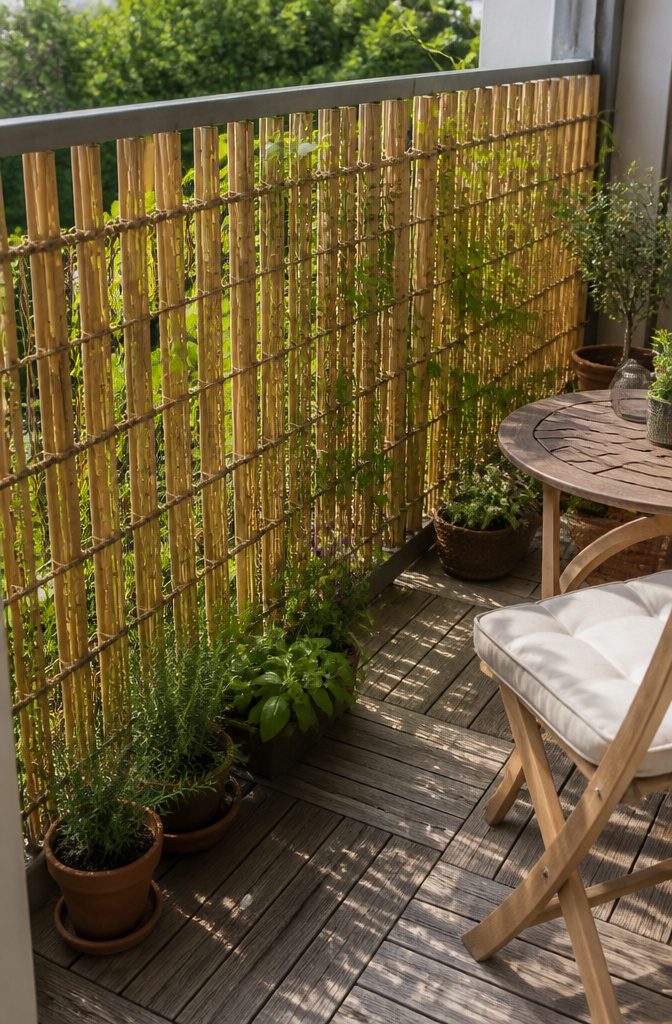
Rolled bamboo screens run cheap and install without tools, which makes them the first stop for most renters after seclusion.
The standard move is to unroll them horizontally along the railing and lash them with zip ties or twine through the gaps. No drill, no deposit risk.
The catch shows up two or three winters later in climates with real rain and snow. Bamboo left wet freezes, splits, and turns gray in patches.
At that point the screen still blocks sightlines but looks like neglected fencing. Plan on replacing bamboo every few years if you are not in a dry zone.
Faux ivy or live vines threaded through slatted rails give a greener look without the full decay cycle.
Live plants obviously demand sun and watering discipline; faux versions skip both but bake to a plastic sheen in strong southern exposure. Wind is where any lightweight screen fails.
Bamboo catches gusts like a sail and rattles against metal railings until the ties wear through. Heavier woven reed holds steadier but costs more and still needs checking after storms.
The plant-based options, real or fake, let air through better and flap less, though a full wall of faux ivy will tear at the cable ties eventually.
For attachment, nylon cable ties through railing balusters work on nearly every rental balcony and cut clean with scissors at move-out.
Reusable gear ties last longer but cost more upfront. Either way, the wind test comes the first thunderstorm, not the afternoon you hang them.
5. Ambient Lighting
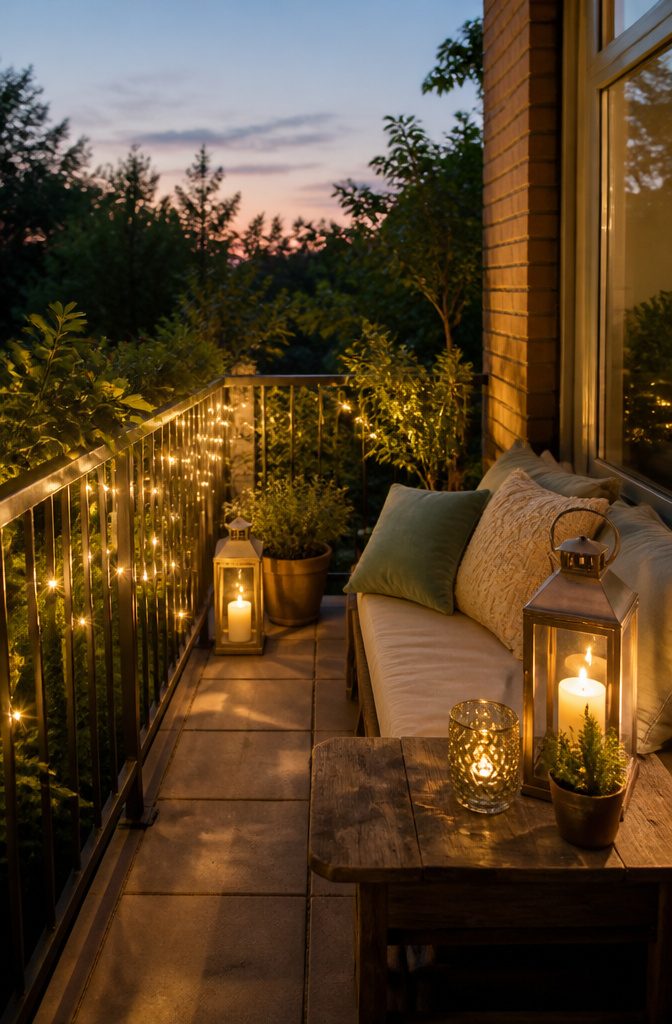
Solar-powered stakes were the first thing I tried out there, mostly because the balcony had no exterior outlet and I refuse to run a cord through the patio door.
They charge fine during the day, but by 10 PM the glow is down to a faint suggestion you have to look for to find.
Battery-operated fairy lights on a timer turned out to be the reliable choice for actual evening use.
They run off three AA batteries, cost about the same as the solar set, and stay bright until you turn them off. The globes that change color are fun for summer, though the battery drain is faster.
Hanging them took some trial and error. 3M outdoor strips failed after two humid nights, so I switched to small Command hooks rated for exterior paint, the kind with the stretch-release adhesive.
They hold string lights fine and pull off clean at move-out. Stucco renters have fewer options; battery-operated lanterns that sit on the rail or a small table skip the wall entirely and still give that layered glow.
Battery swaps land in early April and late September for anything on a timer, sooner if you run color-changing globes nightly.
I keep a pack of AAs in the outdoor bin now so the lights don’t sit dark for a week while I forget to buy them.
6. Outdoor Rugs
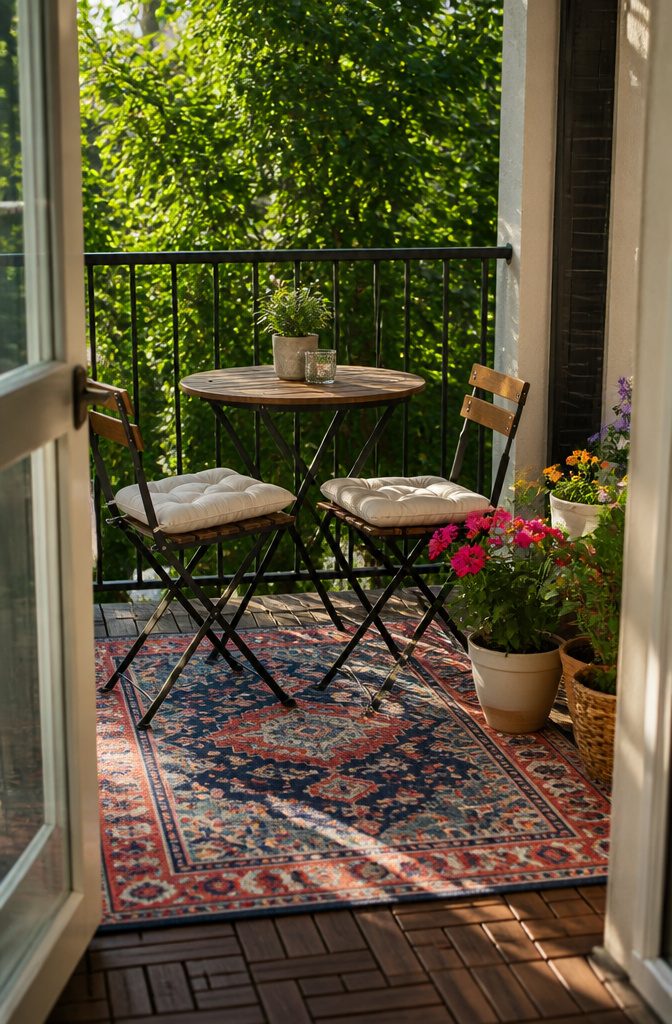
A 6 by 9 foot polypropylene rug runs about $40 on Amazon, which is where most owners on Reddit seem to find theirs.
Synthetic flat-weave fibers do not absorb water, resist mildew, and dry fast after rain, so the material matters more than the pattern when you are working with an exposed balcony.
Size tricks the eye more than furniture placement does. A rug that sits under every leg of your seating, rather than floating in the center, reads as floor and not as an accent, which pushes the walls outward visually.
Owners on Reddit mention lifting the rug periodically so the balcony surface underneath dries; trapped moisture is what damages the deck, not the rug itself.
Cleaning is hosing it down. Pollen rinses off polypropylene with plain water, and mildew that forms on the surface, not in the fibers, lifts with the same treatment.
The plastic weave is light enough to drag over the railing for drying, which is useful when your outdoor storage is a closet you already filled.
7. Hanging Planters
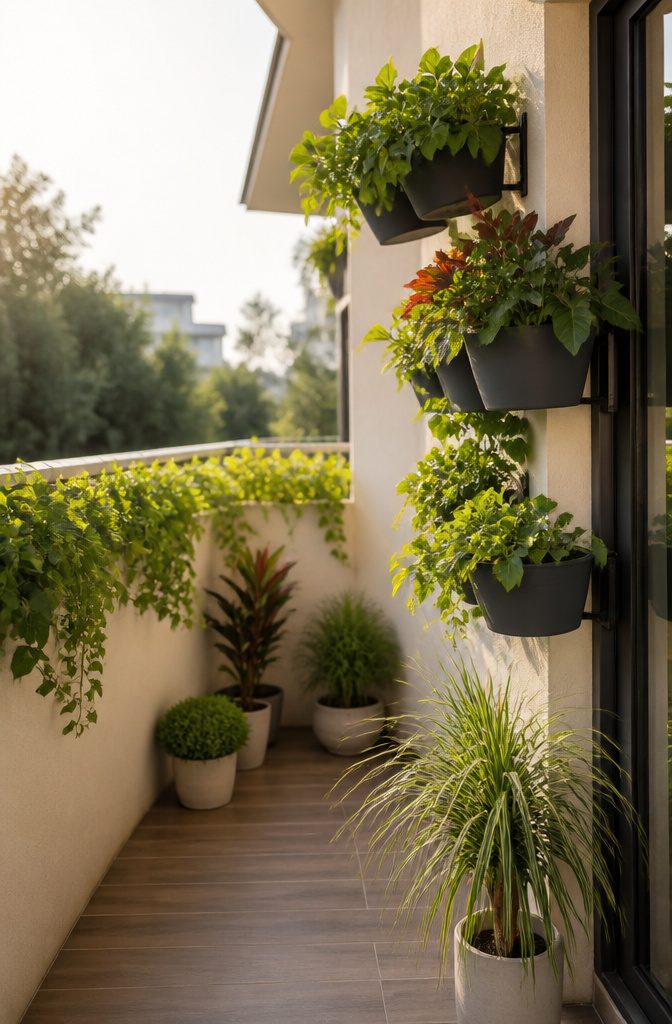
Rail-mounted planters turn a narrow railing into a garden without sacrificing the little floor space a small balcony has.
I learned the weight limit the hard way: a terracotta-filled bracket I thought was secure pulled loose after three days of rain soaked the soil.
Keep the total load under 15 pounds per bracket, and that includes the planter, wet dirt, and a mature plant. Plastic and resin boxes look cheap up close, but they survive the math better than ceramic.
Wall-mounted pockets and felt columns hang on concrete or brick with masonry hooks, though stucco crumbles if the anchor isn’t deep enough. The soil in suspended planters dries out faster than ground beds, sometimes in a single hot afternoon.
Succulents and trailing pothos handle the stress; basil and lettuce wilted on me by July. A drip tray is non-negotiable unless you want stained siding and angry neighbors below.
8. Cozy Textiles
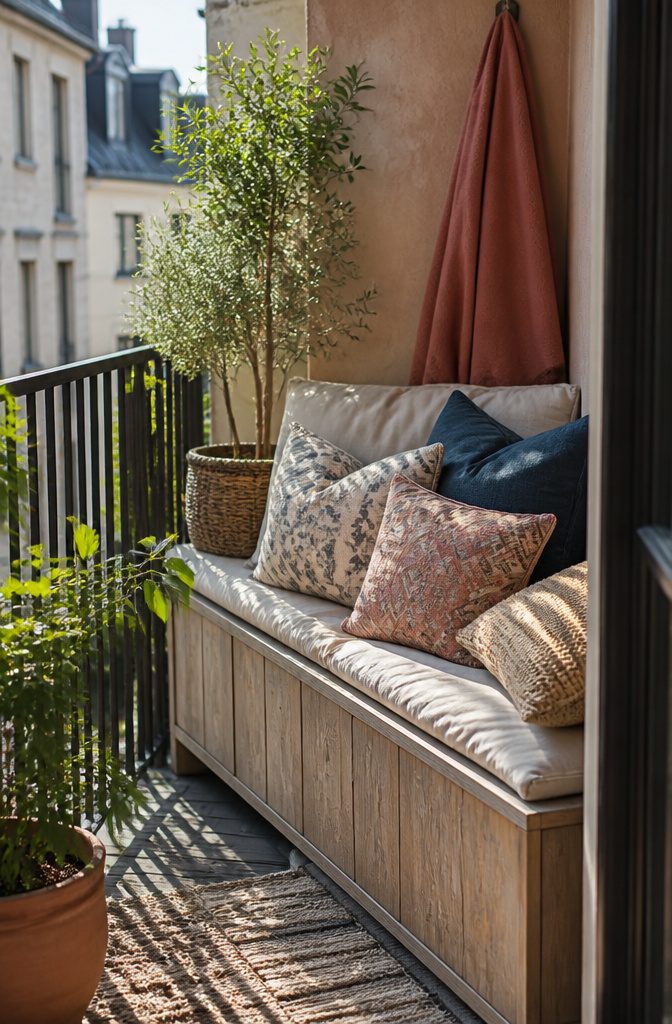
Outdoor cushions look inviting in the store, but the fabric decides whether they last past August.
I learned this after a set of standard polyester covers faded to a dull salmon by Labor Day and held water like a sponge through three rainy weeks.
Marine-grade stitching and quick-drying foam cores are the difference between furniture that survives outside and furniture that lives in your bathtub, dripping.
The Norwegian balcony with the draped blanket against the doorframe works because that spot stays mostly dry.
For fully exposed rails, discount stores like HomeGoods carry outdoor-rated options, though the real test comes after the first downpour. If your balcony is partially shaded, repurposed indoor cushions can work, but only if you bring them in.
Storage is where small apartments kill the project.
I keep my folded textiles in a narrow under-bed bin; the lounger cushions from my Toronto-inspired setup compress flat enough to slide behind a dresser. Without that off-season plan, the cozy textiles become the clutter you’re trying to escape.
9. Flooring Updates
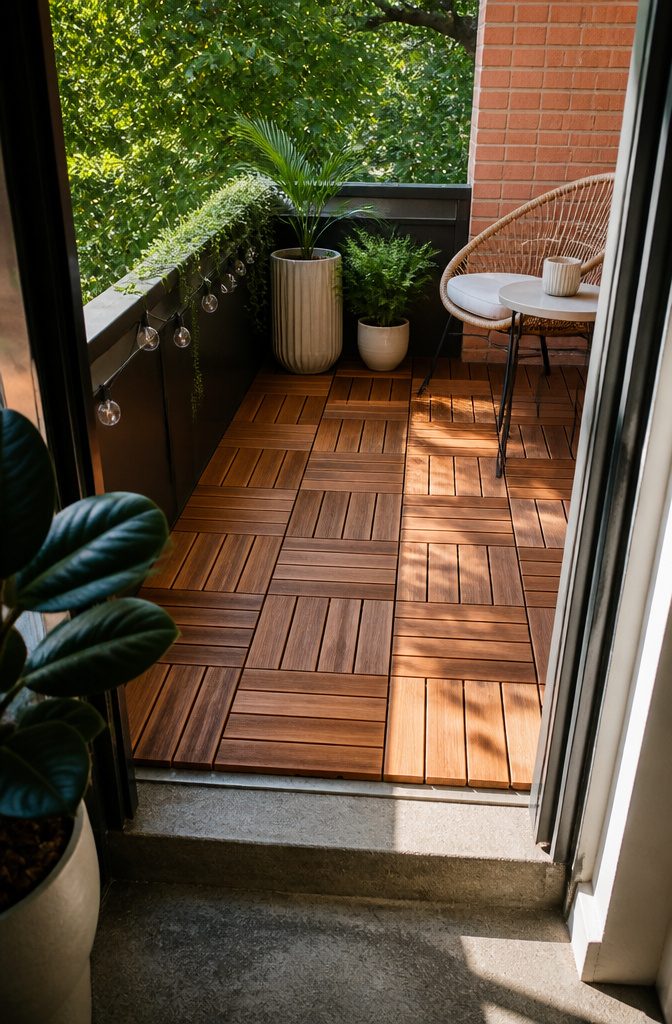
IKEA’s Runnen deck tiles run $17.49 for nine square feet, which covers most small balconies for well under a hundred dollars.
The acacia wood squares click together on a plastic grid base, no adhesive or drilling required, so the concrete underneath stays exactly as the landlord left it.
Owners on Reddit mention that the gaps between slats let rainwater drain straight through instead of pooling on top. What sits below is what you have to think about.
On one Brooklyn balcony where the upstairs neighbor’s drainage leaked, a renter layered a tarp underneath to catch what came through; others simply let the concrete handle it and lifted the tiles to air out the space after heavy storms.
After one winter on my own small balcony, the tiles had shifted maybe half an inch where foot traffic was heaviest.
They never popped apart, but they did not stay locked as tight as day one. The wood itself grayed slightly where snow sat longest, though a quick scrub with soapy water brought most of the original tone back.
For a renter looking at a Saturday morning install, you get a surface that looks finished and feels warm underfoot, with the understanding that you’ll reset a corner now and then and the bare concrete underneath still matters.
10. Zoning
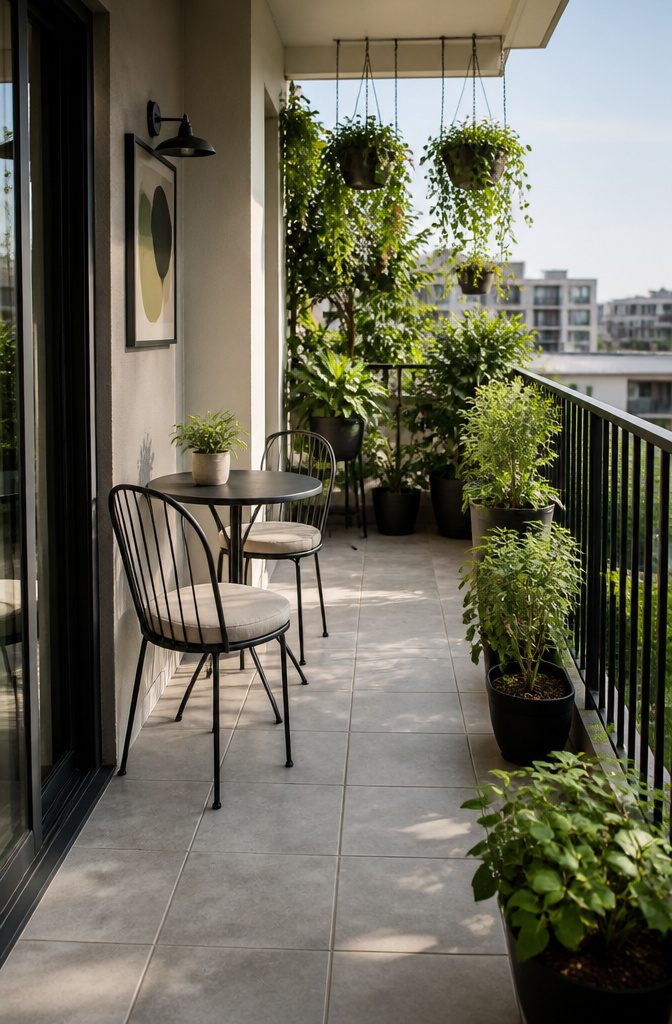
Subdividing a space that already feels like a closet sounds backward until you try it. On my last balcony, about 50 square feet, I started by shoving everything against the railing for the view.
The result was a single cramped corridor where the chair blocked the door, the plants collected in one sun-flooded corner, and the whole thing felt smaller than it measured.
The layout that finally worked put the bistro set against the wall closest to the kitchen door, not the railing.
That preserved a clear walking lane from door to railing, and the sightline across that open floor did more for the sense of space than any mirror could have.
I kept the plant concentration on the opposite wall, using hanging planters and a narrow wall-mounted shelf so nothing sat on the floor to interrupt the line.
Folding chairs made the difference between a dining zone and a permanent obstacle. When they were up, the balcony read as one usable room; when down, two defined spots.
The mistake was thinking I needed all three zones every day. Most mornings, the chairs stayed folded and the space belonged to the plants and the path through them.
Measure Before You Buy
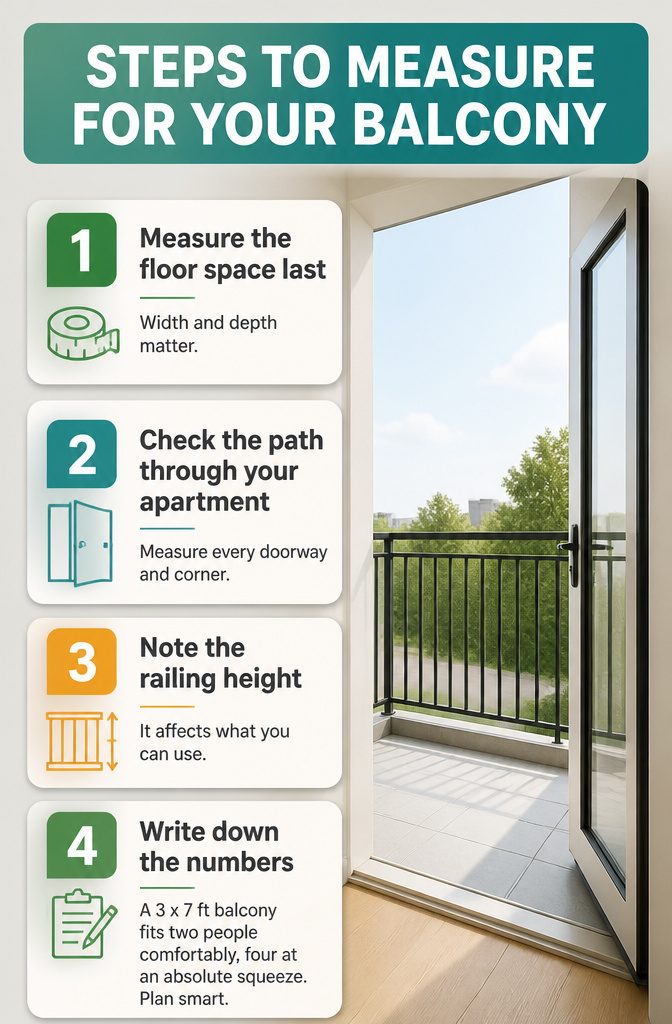
- Measure the floor space last, not first. Width and depth are easy to get wrong if you haven’t already checked whether the door swings inward or outward. An inward swing eats up the first 2–3 feet of usable floor every time the door opens, so that zone stays clear or gets only something you can lift in one hand.
- Check the path through your apartment before you order. My own mistake was a two-seater sofa that cleared the balcony floor plan by two inches on every side but could not make the turn in the hallway. The delivery crew left it in the lobby. Measure every doorway and corner between the street and the railing, not just the final destination.
- Note the railing height if you want anything that rests against it. A privacy screen or planter that sits above the rail line may violate lease rules or local codes, and the gap beneath matters for bracket choices.
- Write down the numbers and carry them. A 3 x 7 ft balcony fits two people comfortably, four at an absolute squeeze, and anything bulkier than a slim chair has to earn its place.
What $300 Buys
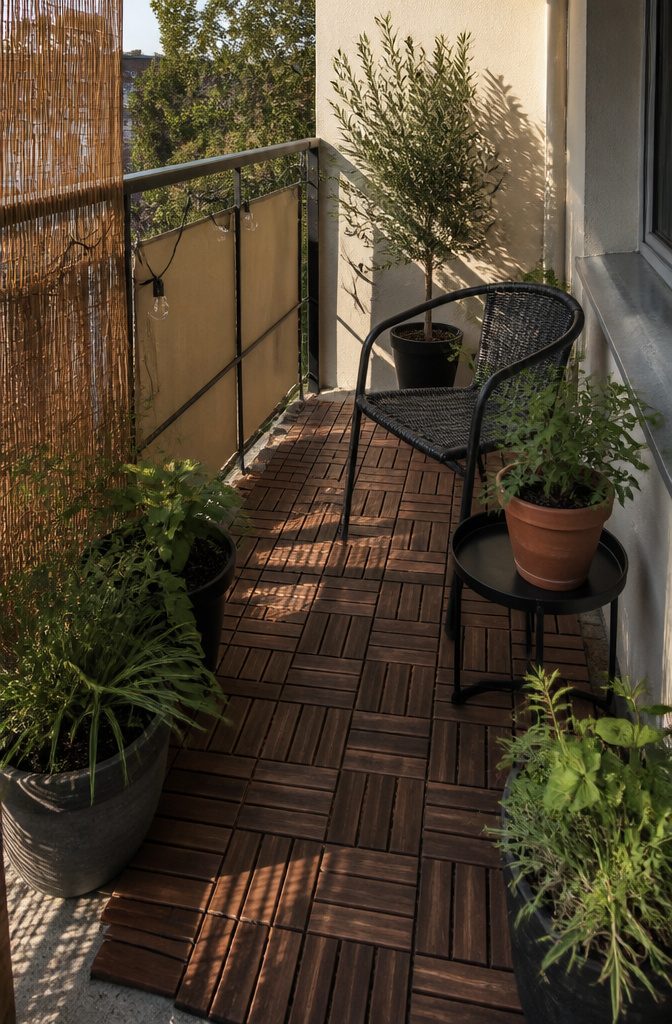
The cheapest part of my balcony ended up lasting the longest. Three years ago I spent $17.49 on a pack of IKEA Runnen wood tiles that clicked together in under an hour over the existing concrete, and they still look fine.
The solar string lights that cost twice as much gave out after two seasons of rain.
That pattern held across the whole refresh.
Rolled bamboo screens attached to the railing ran cheap and held up for a couple of years before weathering rough in heavy rain and snow. Battery-operated lanterns outlasted anything needing an outlet, since most small balconies do not have one.
| Item | Typical spend | Best for | Where to save |
|---|---|---|---|
| Interlocking deck tiles | $17.49 per 9 sq ft | Covering level cement or wood fast | n/a |
| Solar string lights | Mid-range | Ambiance with zero wiring | Skip if heavy rain/snow |
| Rolled bamboo screen | Low | Railing privacy, natural look | Replace every few years |
| Battery lanterns/LED candles | Low | Reliable glow, no outlet needed | n/a |
My total came to about $300 by choosing where to spend versus replace.
The tiles were the one splurge that paid off. Buy the expensive pieces where they matter, and go cheap on everything else you expect to swap.
Plants That Survive Real Balconies

Wind and drought kill faster than shade, so the plants that survive real balconies handle at least one of those.
- Ornamental grasses bend instead of snap in gusts, and their needle-like foliage loses moisture slowly. I lost a pot of lavender to a July heat wave three summers ago; the feather reed grass three feet away looked bored by it.
- Succulents and cacti store their own water and do not sulk when you leave town for nine days. A designer quoted in House Beautiful used cacti on a small deck specifically to add height and color without demanding care; the approach works because tall columnar varieties draw the eye upward and free the floor.
- Dwarf conifers and boxwood take wind that shreds broad leaves. Their woody stems do not turn to straw after one dry week.
- Ivy handles shade that would starve most herbs, though it climbs rather than stands alone. On a railing with no floor space for pots, that habit is the point.
Heavy ceramic or concrete planters keep any of these from tipping. The wide base matters more than the plant choice once gusts hit thirty.
Weatherproofing Mistakes
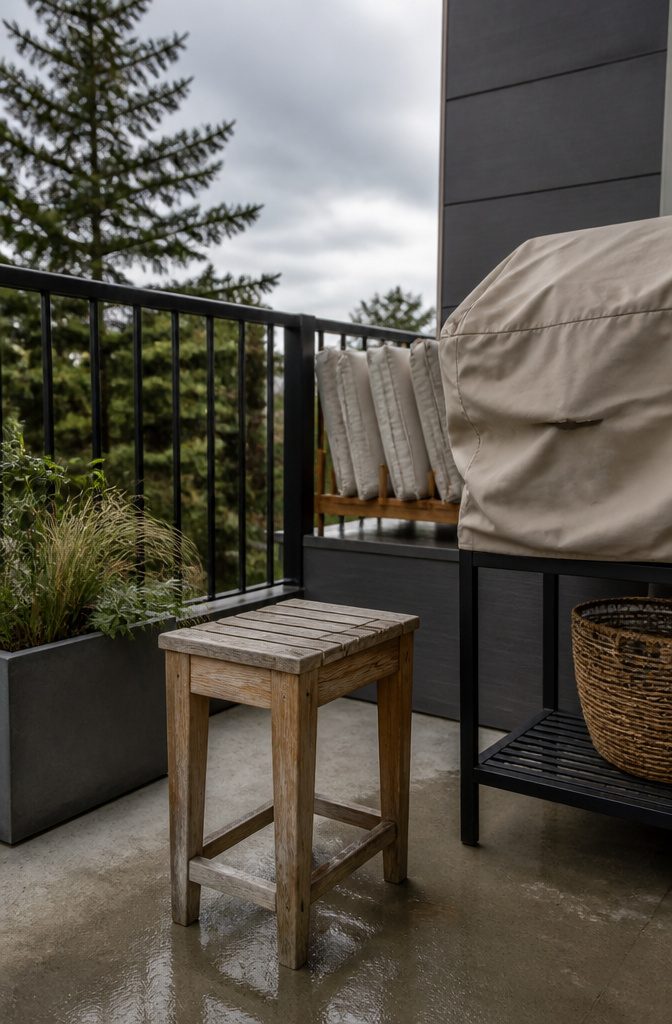
Teak oil on a pine stool looked great for about six weeks, until the legs started graying and splitting along the grain.
That piece taught me that "outdoor" labels on furniture mean almost nothing without checking what species of wood sits underneath.
Cedar, teak, and white oak handle rain and freeze cycles because their own oils push water out; pine, birch, and most eucalyptus soak it in, swell, and rot from the inside even when the surface still looks fine.
Metal follows the same rule by alloy, not label.
Cast aluminum and powder-coated steel survive a Boston winter on my neighbor’s third-floor fire escape; wrought iron with a painted finish rusted through on mine in two seasons because a single chip let moisture under the coating.
Galvanized zinc layers help, but only where the coating stays intact. Any scratch becomes a channel.
Without garage or basement storage, the move is vertical and covered. A deck box rated for UV exposure holds cushions and textiles through December; wall-mounted brackets behind the railing keep folding chairs off the floor where ice pools.
The cheapest insurance is a fitted cover with a vent flap, because trapped condensation breeds mildew faster than open rain.
Weekend Project Order
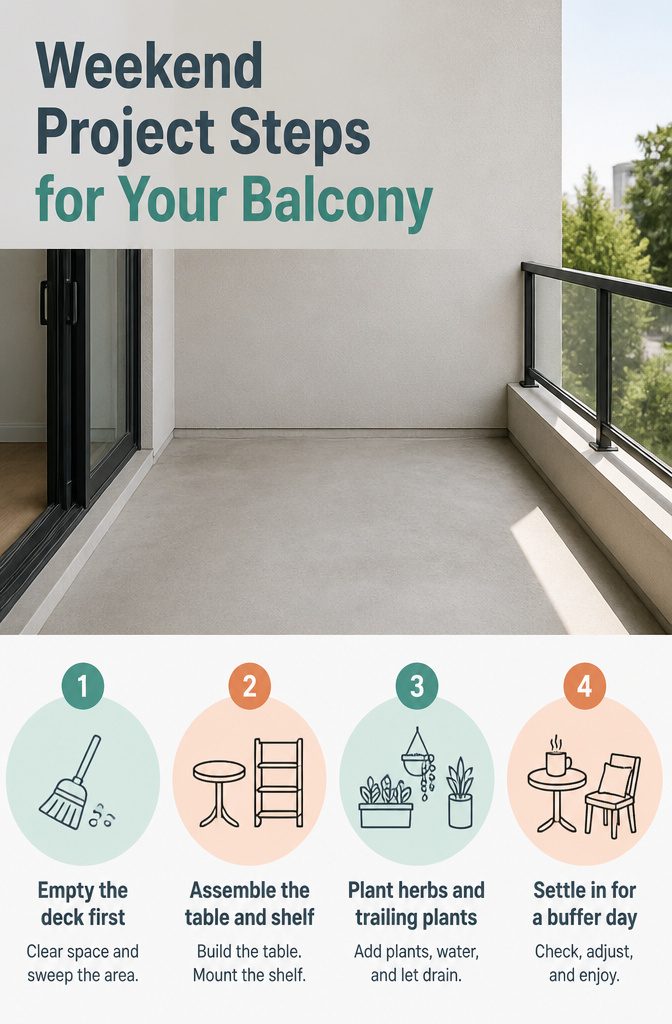
- Saturday morning, the deck needs to be empty before anything new arrives. I move the old resin chair and the half-dead fern to the hallway, sweep the concrete, and mark where boxes will land so the delivery path stays clear. Everything wider than 32 inches goes through the living room door, so that doorway is the real limit on what fits.
- By noon the bistro set and shelving are out of their boxes. I assemble the table first because it becomes the work surface for everything else. The wall shelf goes up next, mounted with a level and two brackets rated for outdoor use, and I hang the planter bars before any soil is open.
- Saturday afternoon is planting. Herbs in the rail boxes, trailing stuff in the hanging pots, one upright plant in the floor planter. I water everything in place and let it drain while I still have daylight to spot leaks or drips on neighbors below.
- Sunday is buffer. The rug unfurls and flattens, the cushions come out of plastic, and I sit out there with coffee to notice what wobbles or catches wind wrong. One bracket gets tightened, one pot gets moved for better sun. By Sunday afternoon the space is workable; by Monday morning it is actually used.
Frequently Asked Questions
How can I make a tiny balcony look bigger?
Preserve clear sightlines by placing furniture against the wall closest to your door, not the railing, and keep a 24-inch walking lane open.
A rug that sits under every leg of your seating reads as floor rather than an accent, which pushes the walls outward visually.
Wall-mounted planters and hanging systems draw the eye upward and free the floor, helping a tight balcony feel less like a ledge and more like a room.
What are the best plants for a windy high-rise balcony?
Ornamental grasses, succulents, dwarf conifers, and woody shrubs like boxwood handle gusts that snap delicate stems. Their flexible or needle-like foliage bends instead of breaking, and succulents store their own water through dry spells.
Heavy ceramic or concrete planters with wide bases keep containers upright; narrow plastic ones will skate across the tile in a strong front.
How do I protect outdoor furniture and decor from weather damage?
Choose materials with real exterior credentials: cedar, teak, and white oak for wood; powder-coated steel or cast aluminum for metal. Standard polyester covers fade and sponge water, so look for marine-grade stitching and quick-drying foam cores on cushions.
Store textiles indoors or in a UV-rated deck box during humid months, and use fitted covers with vent flaps on larger pieces to prevent trapped condensation.
What is a really small balcony called?
A balcony under about 60 square feet is often called a micro-balcony, Juliet balcony, or simply a small balcony in rental listings.
What are some ideas for a minimal balcony?
A single folding bistro chair and a wall-mounted drop-leaf table eliminate legs entirely and clear the floor in seconds. One storage bench holds tools and empty pots while cushions live inside, full stop.
Rail-mounted planters and a narrow wall shelf keep greenery vertical so nothing interrupts the walking lane; the result is two defined spots that read as one usable room when the chairs are up.
How to make a balcony feel cozy?
Outdoor-rated cushions with quick-drying foam cores survive real rain without the bathtub storage cycle, and a draped blanket against a partially sheltered doorframe adds soft texture where it stays mostly dry.
Battery lanterns on the rail or small table give layered glow without drilling, and a 6 by 9 foot rug under every leg of your seating reads as real floor.
The coziness depends on an off-season plan: without narrow under-bed bins or behind-dresser space, textiles become the clutter you are trying to escape.