Light for pantry storage only earns its keep when the fixture matches the space it has to work with.
A flush mount deeper than three inches will catch a ladder or a stack of bulk goods in a reach-in, while a pendant needs eight feet of ceiling just to clear your head and the top shelf.
I cracked a glass shade in a seven-foot rental pantry because I measured from the floor instead of from the shelf where the work happens.
1. Flush and Semi-Flush Mounts
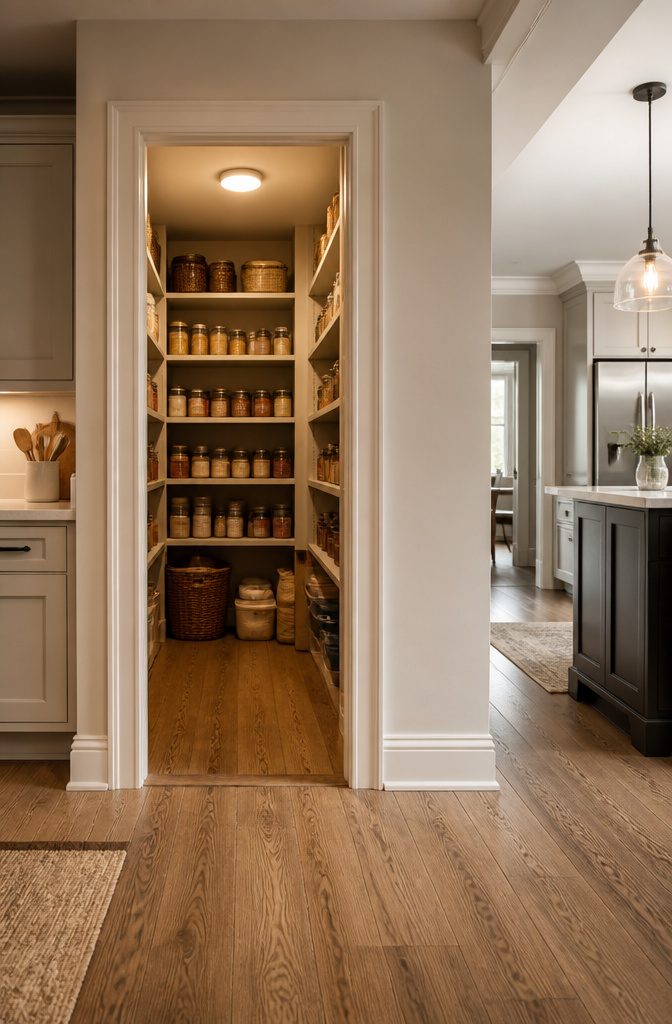
Bare bulb in a 1940s pantry is a mistake you notice three times a day. I swapped mine for a flush mount no deeper than three inches, and the difference was immediate.
The old fixture stuck out just enough to catch a ladder or a stack of bulk goods; the new one sits flat against six-foot-eight plaster, so the whole eight-by-four closet feels walkable.
A semi-flush mount hangs lower, usually four to eight inches, and throws a wider circle of light.
It needs at least seven and a half feet of clearance to avoid a bumped head in a walk-in. For a shallow reach-in like mine, flush is the only shape that respects the real estate.
Lumens matter more than the fixture shape itself. A compact closet-style pantry needs about 800 to 1,000 lumens at minimum to read labels without shadow.
A large walk-in with shelving on both sides wants double that, with the light source placed slightly forward of center so your body does not block what you need to see. drin
2. Pendant Lights
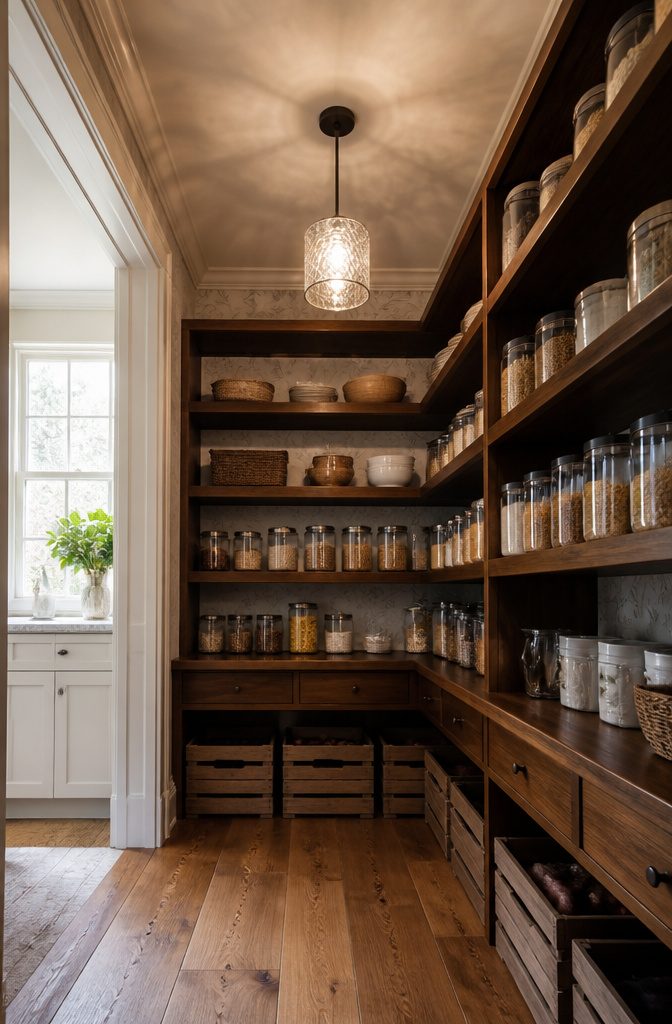
A pendant light in the pantry only works when the ceiling gives you enough room to breathe.
Eight feet is the floor where this starts to make sense, because the fixture itself will drop eighteen to twenty-four inches and you still need clearance above head height and below the top shelf.
Walk-in pantries with actual floor space are the only places that justify it; a closet-deep reach-in is just too small to center one without roasting a cereal box or blocking the door swing.
I learned the hard way in my last rental. The ceiling sat right at seven feet, and I hung a small glass pendant anyway because I liked how it looked in the kitchen.
Two days later I was up on a step stool rearranging flour canisters and the back of my head cracked the shade hard enough to spider it.
The bulb survived; my pride and the fixture did not. The mistake most people make is eyeballing the height from the floor instead of measuring from the shelf surface, where the work actually happens.
In an 8-foot walk-in, that still leaves you plenty of room. At seven feet, you are buying a headache.
3. Track Lighting
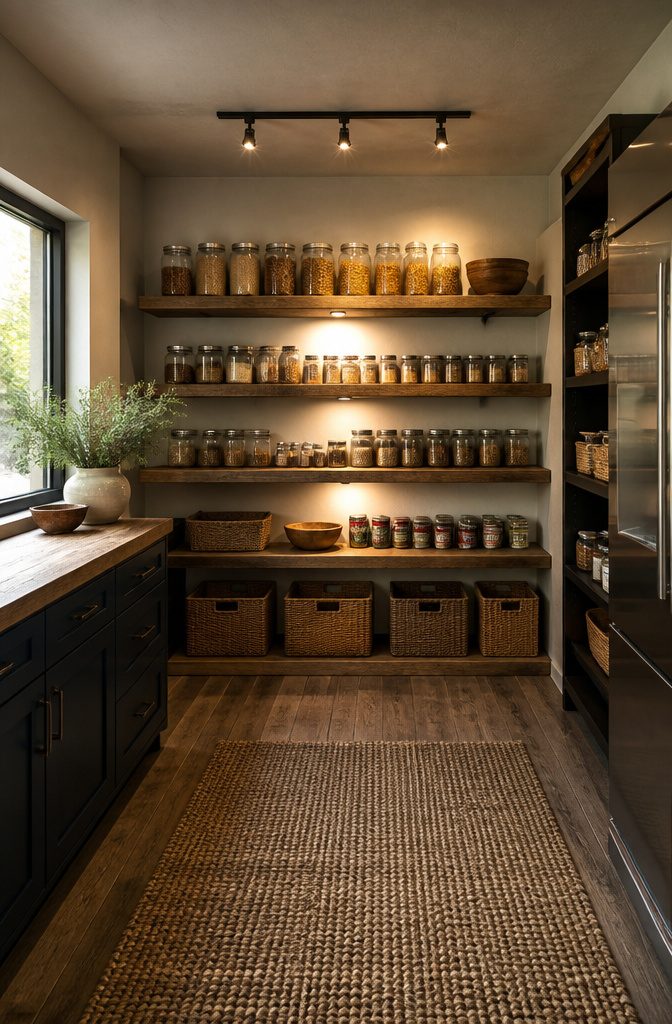
Track lighting wins the same way it wins in a long hallway or a galley kitchen: the heads pivot and slide.
In an L-shaped pantry, that means one ceiling box can cover two walls instead of chipping out more drywall for a second junction.
I put a 4-foot track in a closet-turned-pantry that wrapped around a corner, three shelves on the left wall, two on the right, then a short back wall with the baking pans.
Each of the three heads got aimed at a different wall: one high for the top shelf of dry goods, one mid for everyday spices, one low and angled into the shadow the door cast on the back wall.
No second wiring run, no extra switch.
The tradeoff is glare.
Aimed straight down into a white pantry, the heads throw hard spots that can read as clutter instead of clarity. I left the bulbs at about 30 degrees off vertical, which spread the light without flattening it.
If your shelves are painted a darker color, you will need that angle even more, or the light dies at the front edge and the back row of cans disappears.
4. Under-Shelf LED Strip Lighting
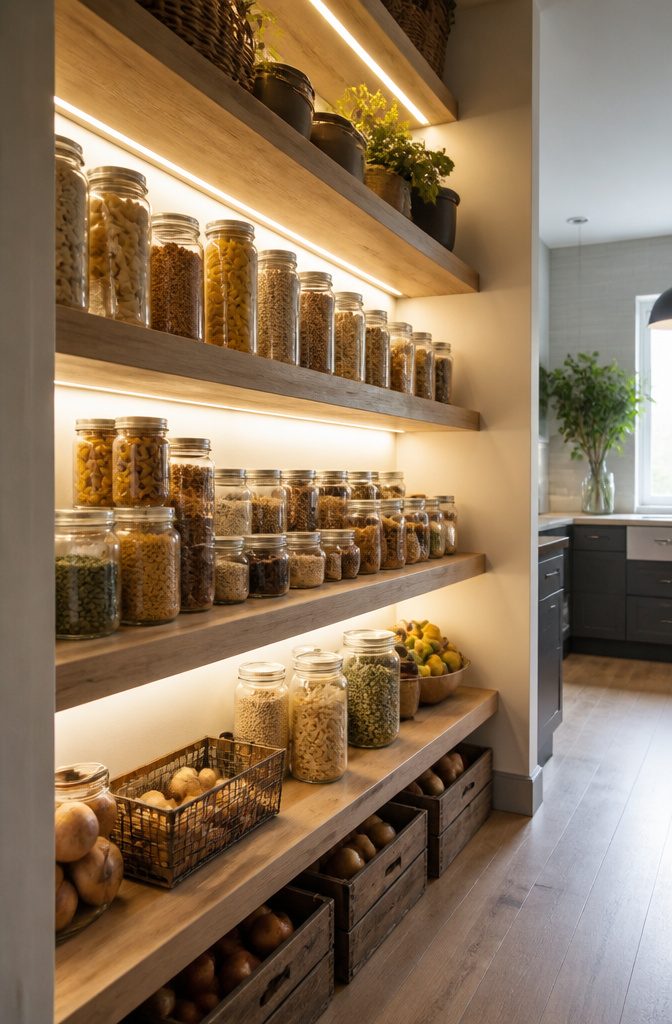
Overhead fixtures in a pantry leave the shelf below them in shadow, and the shelf below that in deeper shadow.
By the time you are crouched at the bottom trying to read whether a tin is black beans or tomato paste, the light is doing almost nothing for you.
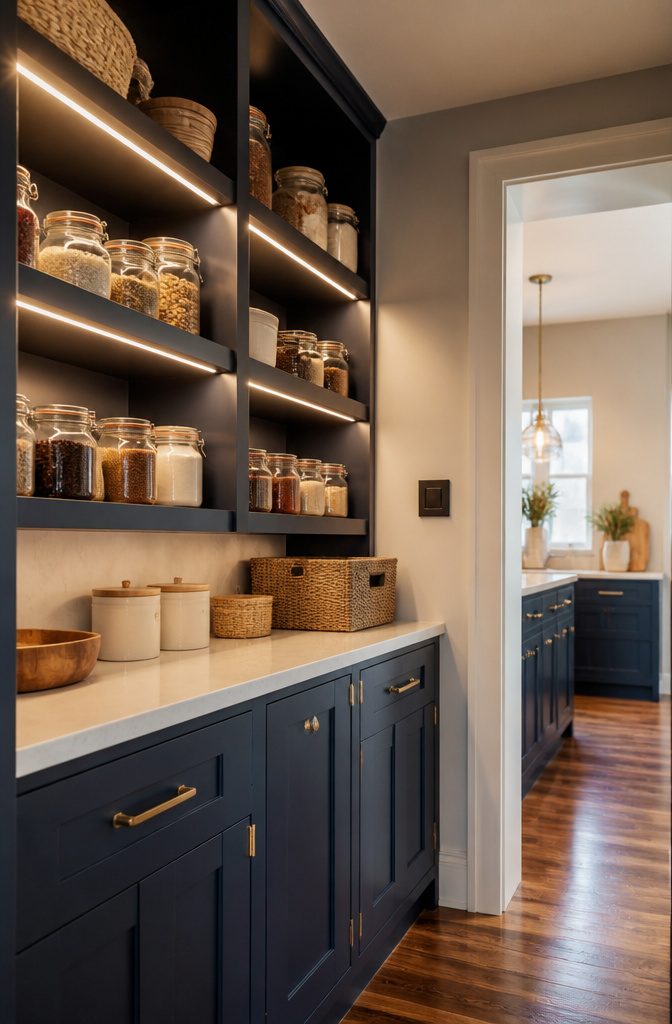
Under-shelf LED strips fix this by placing the source on the underside of each shelf, directly above the jars and cans.
Installation is light work. Double-stick foam tape holds most strips firmly to painted wood or laminate, and the strips are slim enough that a few small screws through their mounting clips do not weaken the shelf above.
Some kits include both; I used the tape on a painted pantry and have not had a strip drop in two years of daily door slams.
The fixture that made the difference for me was the Barrina LED T5 Integrated Fixture, 4FT, 2200lm, 20W.
The 4000K daylight glow sits right between warm and clinical, and at 2200 lumens it is bright enough to read spice labels without tilting the jar toward the door.
The built-in on-off switch means no wiring beyond plugging it in, which matters in a rental where you cannot open the wall.
5. Motion-Activated Lights
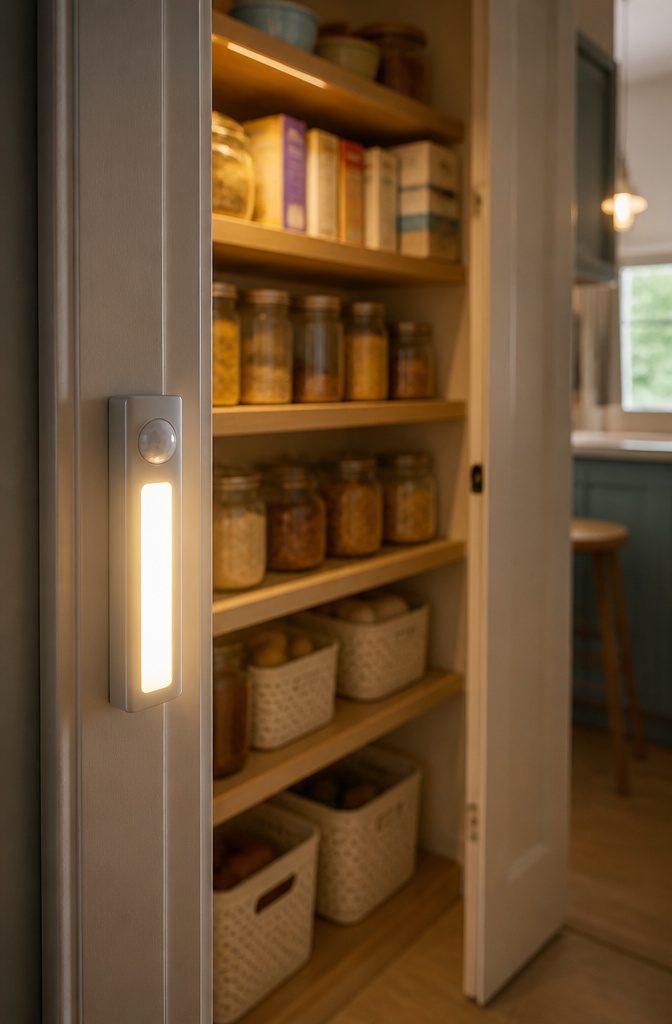
Door-triggered motion sensors for pantry use usually mount on the jamb and switch the light on the instant the door swings past them.
Most units time out after a few minutes of no additional movement, so the bulb does not stay burning if you forget to close the door.
Hardwired versions tie into existing switch legs and need a neutral wire at the box, which a 1920s bungalow I rented in Chicago did not have.
I ended up with a battery-powered LED bar that stuck to the frame with foam tape and ran on three AA cells.
The sensor caught my shoulder as I pushed through with grocery bags, and the light was already on before I could have hit a switch. I changed those batteries maybe twice in two years.
If your pantry sits near an outlet, a plug-in driver with a small drilled hole through the cabinet wall eliminates that chore entirely, though that assumes you are allowed to modify the cabinet and feel comfortable making the hole.
6. Recessed Can Lights
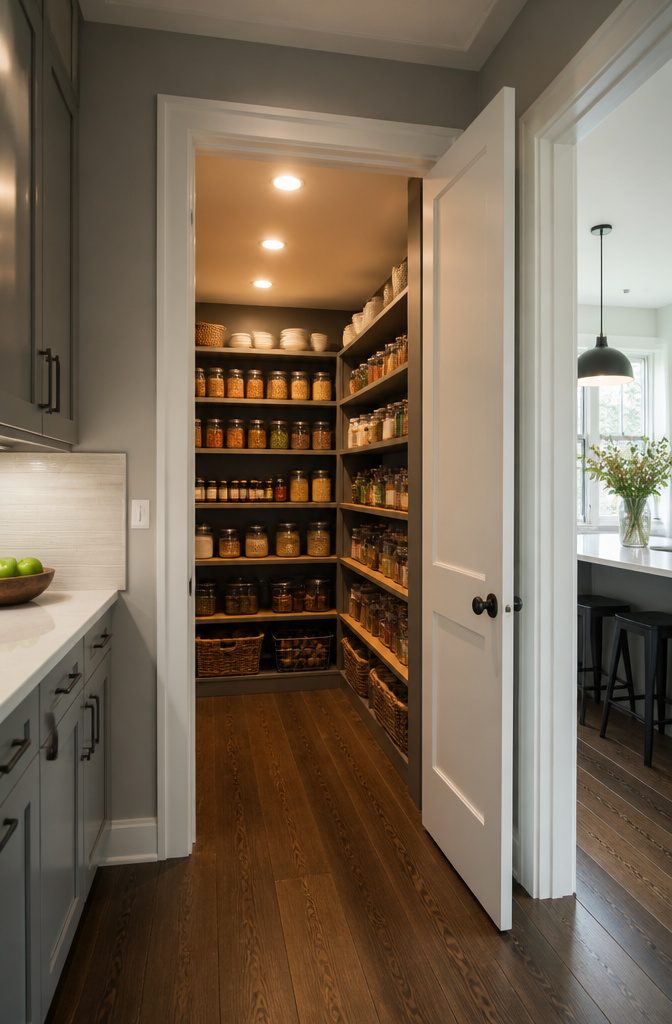
Recessed can lights cast that broad, even glow the clean-look crowd wants, but they ask for ceiling work that only pays off in a space you own.
I skipped them in my last rental; cutting holes and dealing with a landlord’s repair clause at move-out was not a weekend I wanted to spend.
In the house I bought two years later, I put them in during a broader kitchen reno and the result was worth the mess.
Plan for roughly one can per 25 square feet of pantry, spaced so the beams overlap without leaving the back corners in shadow.
Older incandescent housings run hot enough to matter in a small enclosed space where you store food; that heat is one reason the switch to LED retrofits makes sense beyond just the energy math.
The LED boards drop in without touching the ceiling drywall again, and the temperature difference is immediate when you reach up to swap out a cereal box.
7. Puck Lights
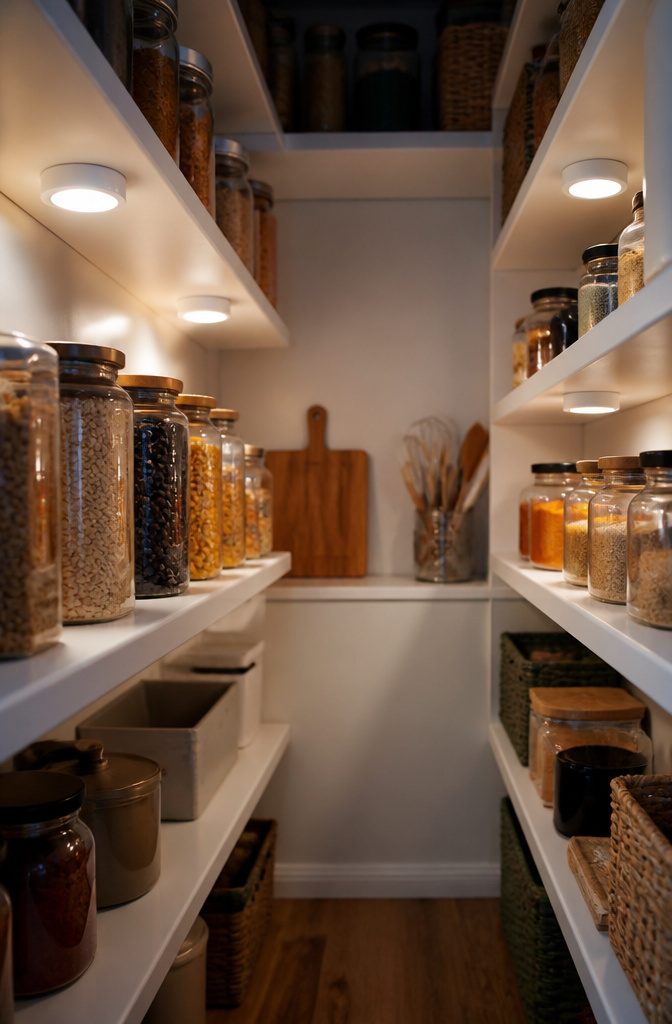
Battery-powered LED puck lights are the fastest way to throw light into a dark pantry corner without touching a wire.
Peel off the backing, stick them under a shelf or against the back wall, and the space opens up immediately. A six-pack runs about $24, which makes the experiment cheap enough that regretting it later costs almost nothing.
That is the catch. The batteries fade long before the LEDs do, and the dimming happens so gradually that you stop noticing until you are squinting at a soup label.
Rechargeable versions exist at $26 or $40 for motion-sensing pairs, but even those tether you to a cycle of pulling fixtures down, charging them, and hoping you remember to reinstall before the next grocery trip.
I wired in something proper after eight months of three puck lights stuck under a deep shelf. The light had softened to a glow, and replacing the cells one more time felt like feeding a pet that never got full.
Color Temperature for Pantry Lighting
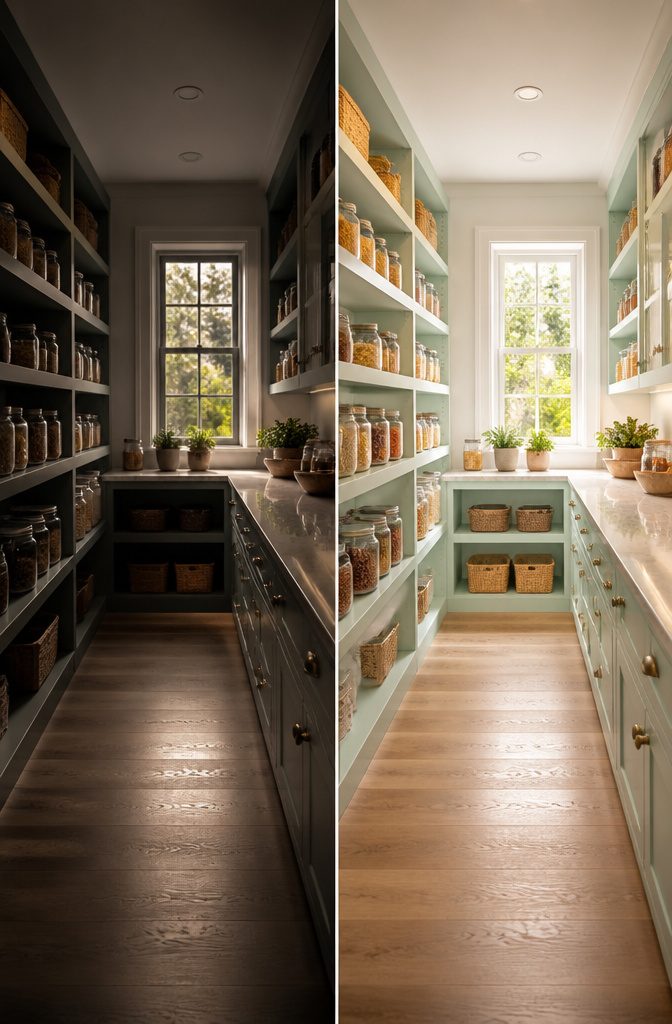
The 3000K to 4000K range is where pantry lighting actually earns its keep.
Go warmer than that and the yellow cast starts flattening everything out. I learned this the hard way after swapping in some 2700K bulbs I had left over from a bedroom project.
Suddenly my dried beans all looked like the same beige gravel. The navy lentils and the black beans were nearly indistinguishable, and the spice tins I had labeled in fine Sharpie turned into unreadable smudges.
The light felt cozy, which is fine for a living room, but a pantry is a workspace where you are reading small print and sorting colors.
Neutral white at 3000K gives enough warmth to keep the space from feeling clinical, while 4000K pushes crisper contrast if your shelves run deep and shadowy. Either beats guessing whether you just grabbed cumin or coriander.
LED Benefits for Food Storage
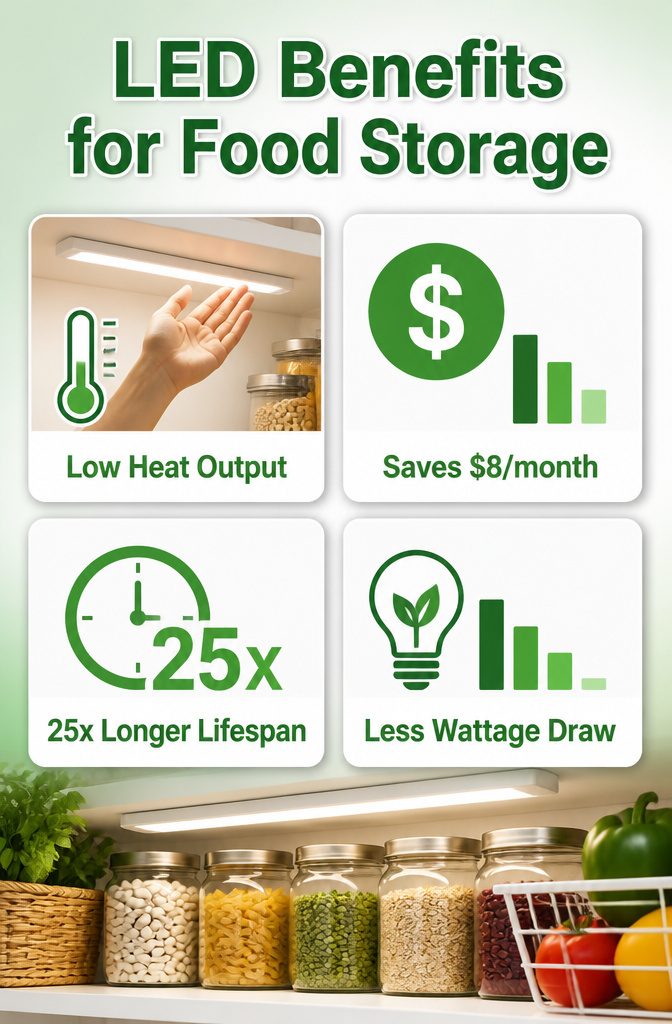
LEDs run cool enough that you can hold your hand against the lens after hours of use. In a small enclosed pantry, that low heat output matters more than it might in a walk-in closet or a garage.
A hot bulb slowly warms everything around it, and food stored against the wall or on upper shelves sits in that heated pocket.
Switching my own pantry from two 60W incandescent bulbs to LED strips dropped the temperature inside by a noticeable margin, and the electric bill fell by about eight dollars a month for that single fixture pair.
The LEDs draw a fraction of the wattage, and the rated lifespan runs roughly 25 times longer than the old bulbs I was replacing every eighteen months.
For a light that gets flipped on five or six times a day, that longevity means you stop keeping spare bulbs in the junk drawer.
Combining Overhead and Task Lighting
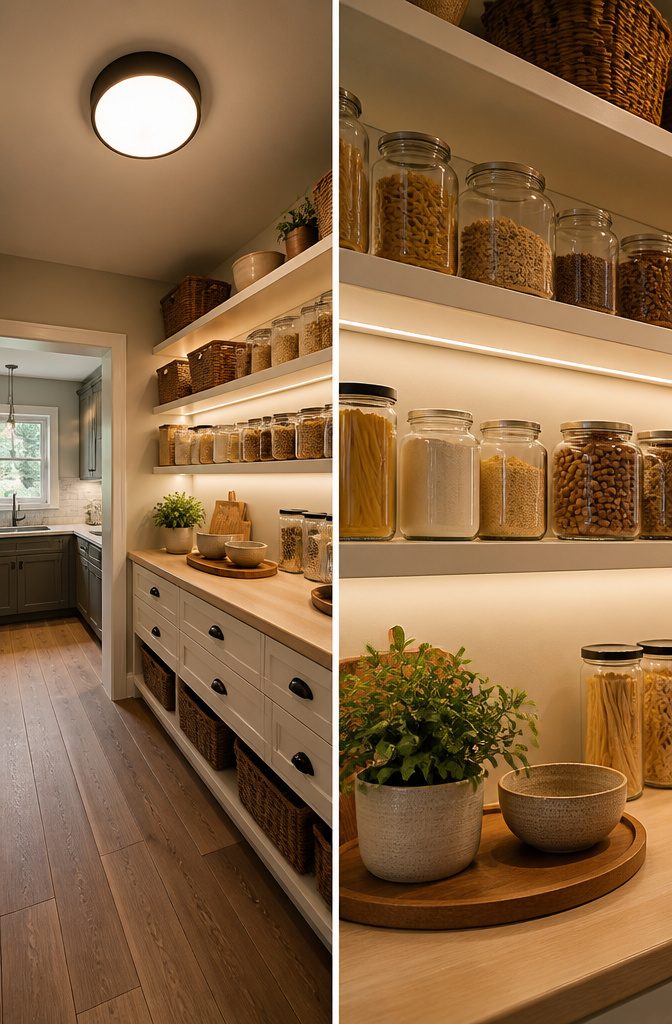
A single overhead bulb in my pantry left the lower shelves in shadow no matter where I stood.
The light hit the top of the cereal box while the back row of cans went dark, and my own body blocked what little reached the middle shelf when I leaned in to grab something.
The fix is two layers, not one brighter bulb. I added a flush-mount ceiling fixture for overall light, then ran two LED strip lights underneath the shelves themselves.
The overhead handles the floor and the doorway so I’m not walking into a cave. The strips handle what the overhead cannot: the shelf cavity itself, where cartons and jars stack deep enough to swallow their own shadows.
Color temperature matters across both layers. I kept both at 3500K, a neutral white that sits in the range where colors read accurately.
Warm light makes everything look yellowed and tired; anything cooler than 4000K starts to feel like a clinic. At 3500K I can tell black beans from kidney beans without pulling the can into the doorway.
Placement of the overhead matters too. I shifted it slightly forward of center, toward where I stand, so my body casts its shadow behind me instead of onto the shelf I’m reading.
The strips do the rest. The combination cost about the same as a single decent pendant, and the wiring was a Saturday morning, not a weekend.
Automation Beyond Motion Sensors
Smart switches and timers extend pantry lighting beyond the simple on-off of a door sensor, and the Sengled Zigbee LED Strip Lights give you app control and voice compatibility through Alexa or Google Assistant.
You could program scenes, dim to a night light level, or tie the pantry into a whole-home routine.
I stopped at a basic door sensor. The pantry is one room where full smart home integration felt like solving a problem I did not have.
The light turns on when I open the door, off ninety seconds after I close it, and that covers ninety percent of actual use.
Adding an app layer meant another login, another hub dependency, and a higher chance the light fails the one evening I am hunting for tomato paste with flour on my hands. For a single closet-sized space, the simpler setup wins.
Frequently Asked Questions
What types of pantry lighting are best?
Flush mounts, semi-flush mounts, pendants, track lighting, under-shelf LED strips, motion-activated lights, recessed cans, and puck lights all work, but the right choice depends on your ceiling height and pantry depth.
A reach-in closet pantry needs a shallow flush mount no deeper than three inches, while a walk-in with eight-foot ceilings can handle a pendant or track system.
For eliminating shelf shadows, under-shelf LED strips are the most effective addition you can make.
How can I eliminate shadows in my pantry?
Use two layers of light instead of one brighter bulb. Add a flush-mount ceiling fixture for overall illumination, then run LED strip lights underneath the shelves themselves.
Position the overhead light slightly forward of center, toward where you stand, so your body casts its shadow behind you rather than onto the shelf you are reading.
The strips handle the shelf cavity directly, where cartons and jars stack deep enough to swallow their own shadows.
What is the best color temperature for pantry lighting?
Stay between 3000K and 4000K for accurate color reading. Warmer than 3000K and the yellow cast flattens everything out; navy lentils and black beans start looking identical, and fine Sharpie labels turn to smudges.
Neutral white at 3000K keeps the space from feeling clinical, while 4000K gives crisper contrast for deep, shadowy shelves.
The author ran both overhead and task layers at 3500K and could tell black beans from kidney beans without pulling the can into the doorway.
How do motion-activated lights work?
Door-triggered motion sensors mount on the jamb and switch the light on the instant the door swings past them.
Most units time out after a few minutes of no additional movement, so the bulb does not stay burning if you forget to close the door.
Hardwired versions tie into existing switch legs and need a neutral wire at the box; battery-powered LED bars stick to the frame with foam tape and can run for two years on three AA cells with only a couple of battery changes.