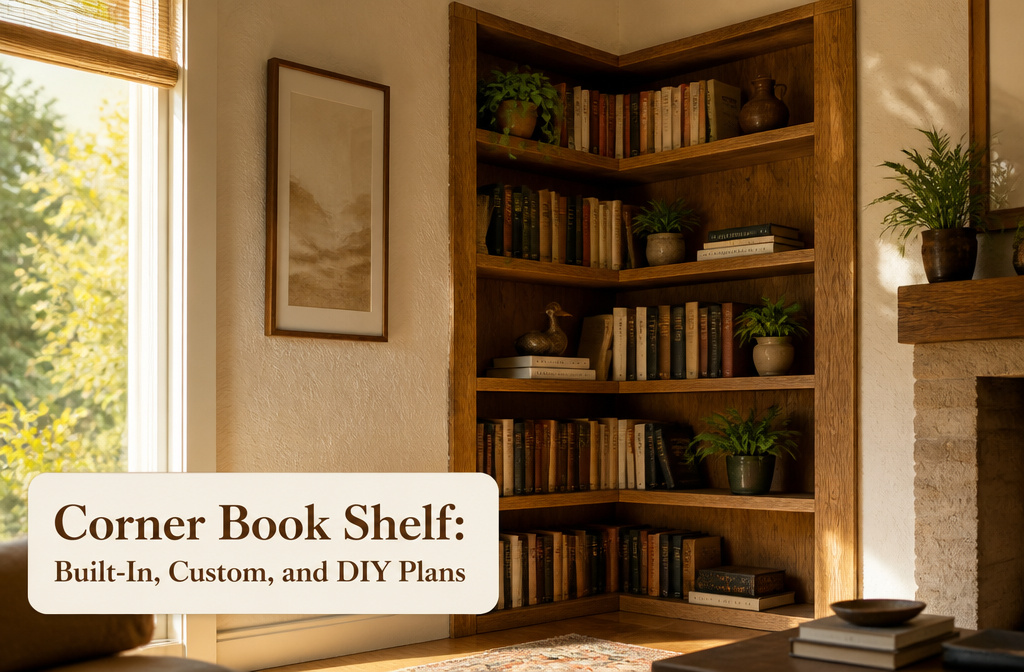
A corner book shelf turns an empty angle into storage, but only if you match the build to how long you will live with it.
The $525 Arthur Brown Shaker unit ships as furniture-grade plywood you carry out at move-out; a built-in anchors to studs and takes your security deposit with it. That permanence is the whole point, and the whole problem.
Custom Corner Bookcases
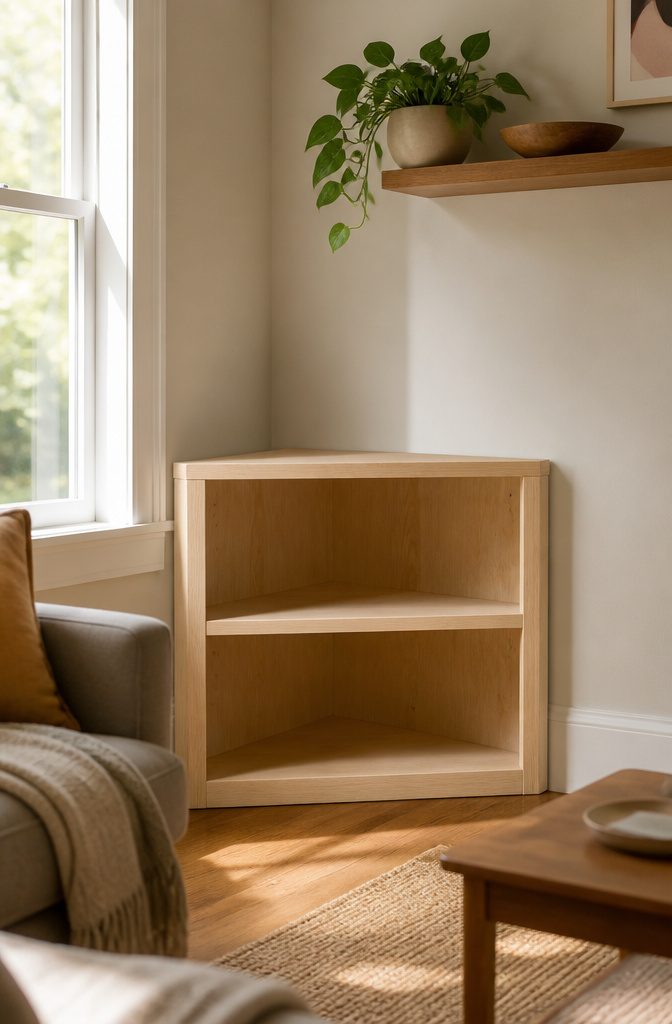
A ready-made corner bookcase that actually earns its price tag is the Arthur Brown unfinished Shaker corner bookcase, sized at 30 inches along each wall, 24 inches high, and 12 inches deep for $525.00.
The construction justifies the cost: 3/4-inch furniture-grade plywood forms the box and shelves, while 3/4-inch solid wood frames the face. No moulding keeps the lines clean.
Customization at this level means choosing your own finish on the bare wood, or stepping up to a taller unit.
The same footprint runs from 24 inches high all the way to 96 inches, with prices climbing to $1,282.00 for the full-height version. Wider 36-inch models with 16-inch depth start at $654.00 if your corner has more room to fill.
The plywood-and-solid-wood combo sits well above particleboard flat-pack quality, though you are still buying a box that slides into the corner rather than one built into it.
For renters or anyone who needs to take it along at move-out, that is often the smarter half of the trade.
Built-in Corner Bookshelf
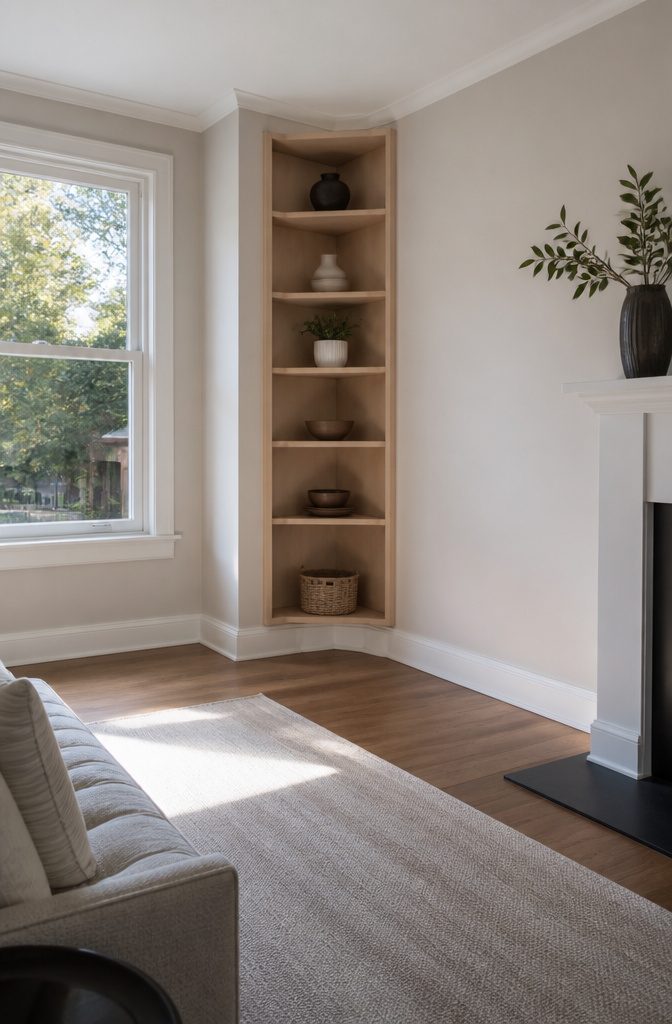
A 3′ x 4′ built-in corner bookshelf anchors directly to the wall studs and becomes part of the room itself, not furniture you can walk away with.
That permanence is the whole point, and the whole problem depending on who pays the rent.
Structural support runs through studs on both walls meeting at the corner, plus a vertical 1×2″ spacer set into the back corner if you want the open look where shelves miter together.
The boxed-in route is simpler: two rectangular cases butted against each other, each carrying its own weight into the walls it touches. Either way, this is drywall surgery, not a weekend you can undo with a dolly.
The first decision is that open corner versus boxed-in corner.
Open gives you the continuous shelf line but fixes every shelf in place; no adjusting later. Boxed-in hides the seam and leaves room for adjustable peg holes.
I have looked at enough of these builds to know the open version reads cleaner in photos and costs more in patience, since you are building in place one shelf at a time rather than assembling cases on the floor.
Renters should skip this entirely unless the landlord signs off in writing. The clean look comes from holes in plaster, and those do not vanish when the lease does.
DIY Corner Bookshelf Plans
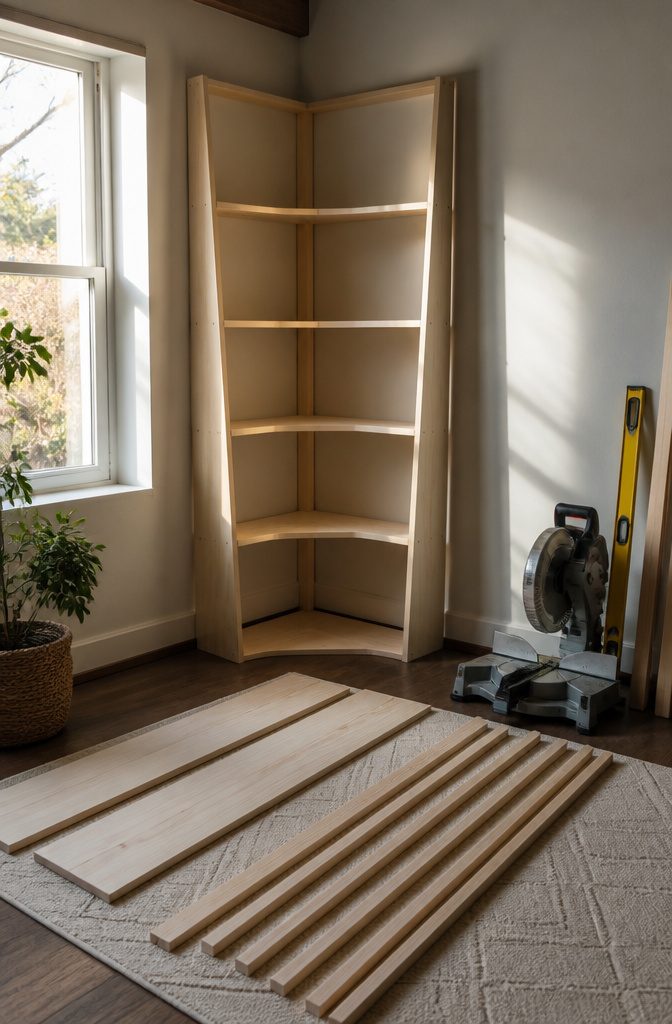
A usable corner bookshelf plan lives or dies on whether every board length is named before you leave the page.
Most free plans stop at a sketch and a wish; the one that actually gets built lists two 1×12 boards at 26-1/2 inches for the side panels, plus 1×2 trim and 2×2 legs cut to their own exact lengths.
That specificity is the difference between a Saturday project and a Sunday trip back to the lumber yard for the board you guessed wrong.
The corner add-on uses the same 26-1/2 inch side panel dimension, which tells me the designer actually built this thing and hit the same wall twice.
The main unit and the wrap-around piece share that cut, so you can batch them together at the miter saw and keep your setup time honest.
Without that number, you are measuring against drywall with a tape measure that keeps slipping off the corner, and the shelf ends up proud of the wall by half an inch you will stare at for years.
Corner End Bookcases
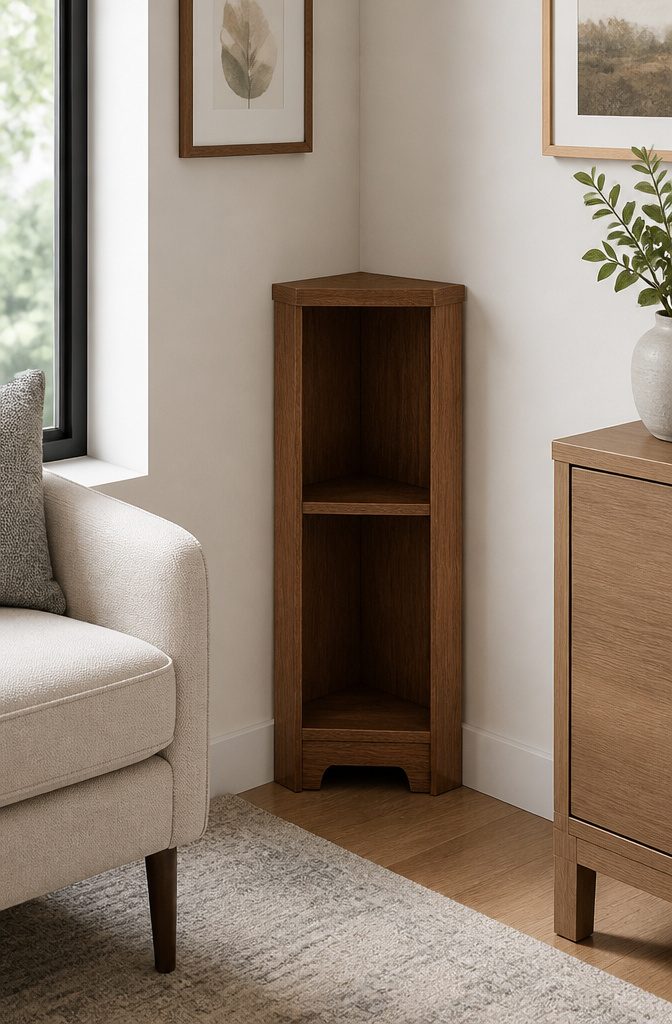
A corner end bookcase is the smallest footprint option that still reads as finished furniture.
The Arthur W. Brown line starts at 12 inches wide, 24 inches high, and 12 inches deep with one adjustable shelf for $297, and scales up to 16 inches wide and 96 inches tall at $910.
That 12-inch unit is the one to watch if you rent a studio and need a book shelf in corner spaces without blocking traffic flow.
These units terminate a wall run or sit alone. They are not built-ins, so you skip the drywall repair and the commitment to a single layout.
I see them used two ways: as a temporary setup that moves with you, or as the first purchase in a system you plan to expand later.
The plywood box with solid wood face frame has no moulding, which keeps the look plain enough to pair with whatever you add next.
Prices run roughly $300 to $900 depending on height and shelf count. The jump from 24 inches to 96 inches in the same width more than doubles the cost, so the practical ceiling for most first apartments is that 48-inch height at $384.
Three adjustable shelves there hold cookbooks, a small plant, and the router you have nowhere else to put.
Around the Corner Bookshelf
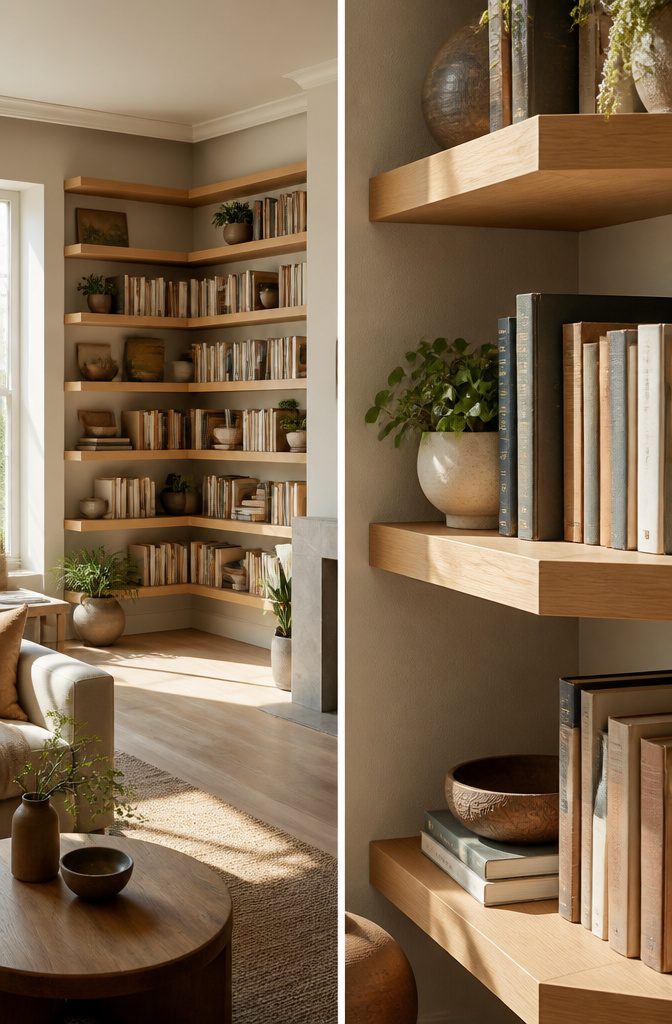
Wrapping shelves around a corner instead of butting two units together changes how the whole wall reads. The eye follows one continuous line, and the corner itself becomes part of the storage rather than a gap to work around.
The geometry forces a few early decisions. A true around-corner build needs the front corners of each shelf board clipped or mitered where they meet at the inside corner, or the boards collide and leave a gap you cannot hide.
I have seen builds where the maker left the front corners square and just caulked the crack; six months later the caulk had torn from seasonal movement.
Clip the front corners at 45 degrees and let the back edge run long into the corner, where a little gap never shows.
Load path shifts too.
A standard shelf carries weight straight back to the wall. On an around-corner unit, the shelf at the bend acts like a brace, stiffening the whole assembly against racking.
That means the corner shelf itself carries more stress than the others, so a thicker board there pays off. I would use stock a full half-inch heavier at the corner, or add a hidden cleat underneath tying both walls together.
The visual effect is what sells it.
Two separate shelves meeting in a corner always read as furniture. One wrapped unit reads as architecture, as if the room grew that way.
The cost is a harder build and less flexibility if you ever want to rearrange, but for a permanent wall in a first home, the finished look is hard to beat.
Open Corner vs. Boxed-in Corner
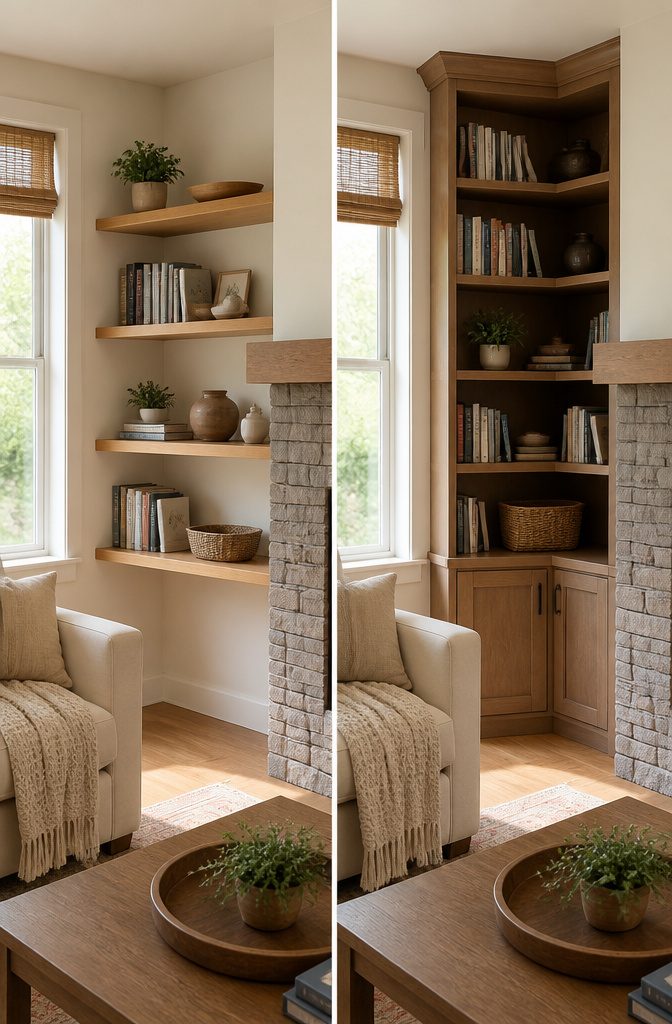
An open corner leaves the wall visible behind the shelves, which keeps the whole piece lighter visually and saves you from wrestling with miter cuts at the back.
The tradeoff is support: each shelf needs a vertical 1×2 spacer in the back corner to carry the mitered joint, and you end up building in place, one shelf at a time, with no chance to adjust later.
I painted the wall behind mine to match rather than adding a back panel, which worked fine until I noticed every brush mark the overhead light picked up.
A boxed-in corner reads as solid furniture and swallows wall imperfections whole. You build two separate shelf units, butt them together, and call it done; shelves stay adjustable because the fixed sides do the structural work.
The catch is material cost and the precision: a gap at the back miter shows from every angle in the room, and there is no trim piece that convincingly hides it.
I have seen that gap caulked, painted, and still catching daylight.
For a first build, the boxed route forgives more sins. The open corner rewards you only if your walls are already straight and your patience for in-place assembly is higher than mine turned out to be.
Adjustable vs. Fixed Shelves
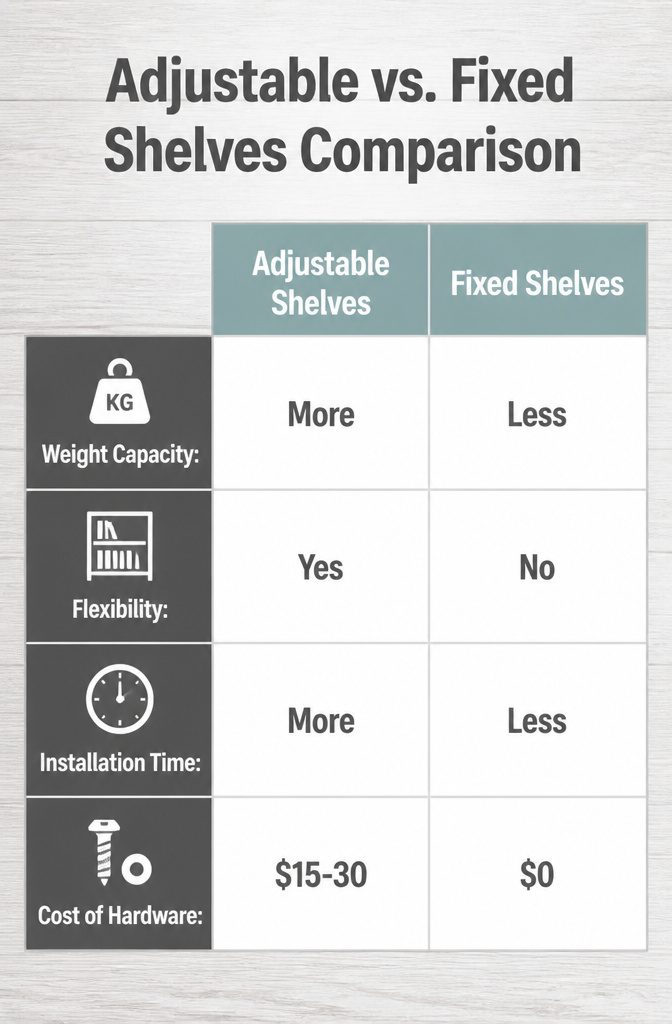
Adjustable shelves win their place when your collection refuses to stay one size.
The peg-hole or track systems cost roughly $15–30 extra in hardware, but they let a single corner unit hold art books upright one month and a stack of paperbacks the next.
That flexibility matters more than I expected before I sorted my own shelves and realized half my books are oversized and half are standard mass-market size.
Fixed shelves trade that movement for strength and simplicity.
A fixed shelf glued and screwed into dado joints carries more weight with less sag over the years, and the build skips the fuss of drilling a straight line of holes that actually line up.
The catch is committing to one spacing forever.
If you own mostly uniform paperbacks, that commitment costs nothing. A mixed collection, or anything with art folios, will fight fixed spacing until you lay books flat and waste the vertical gap above them.
For a first build on a weekend timeline, fixed shelves save about two hours of layout and drilling. The hardware savings are minor compared to the time.
My own bias shifted after helping a friend retrofit peg holes into a fixed unit she had already painted: the drill wandered, the holes blew out, and she wished she had decided upfront.
Materials and Tools for Building
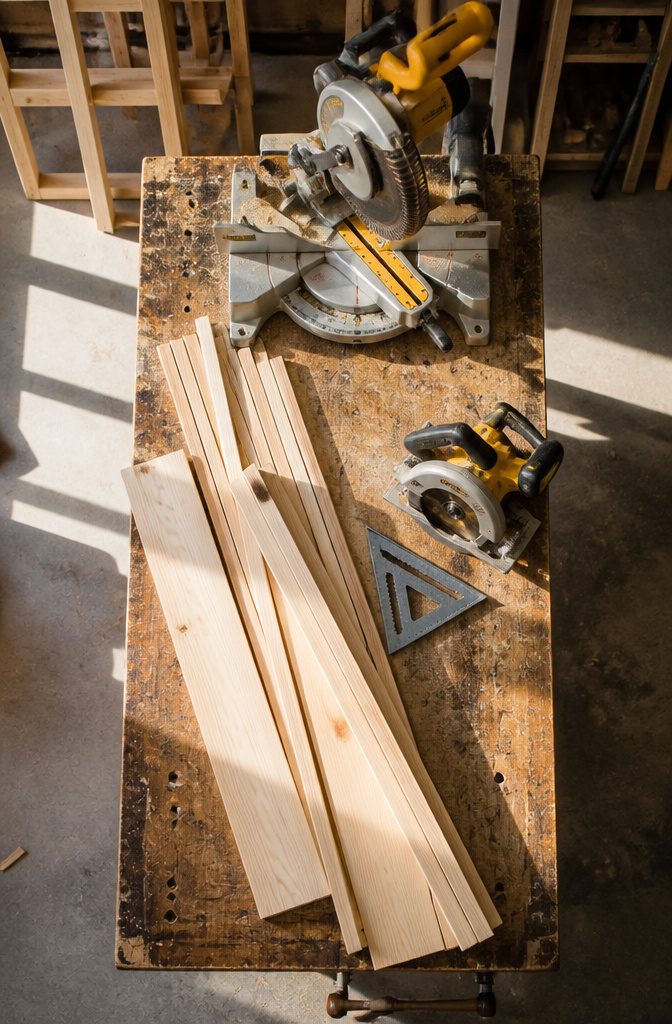
A weekend build of a corner book shelf starts with lumber you can carry in a sedan. The cut list breaks down to 1×2 and 1×12 boards for the shelves and trim, plus 2x2s for the legs and frame.
For the back panels, 1/4-inch plywood keeps the weight manageable. Solid wood on the front-facing edges looks finished; plywood on the back or inside faces is standard and nobody notices.
What most renters already own: a drill and a level.
What you borrow or buy: a miter saw for the angled corner cuts, a speed square to keep joints true, and a random-orbit sander unless you want to hand-sand every shelf.
A brad nailer is not required; screws through the 2×2 frame hold just as well and let you disassemble later.
Furniture-grade plywood works for the 1×12 shelf boards if you edge-band the front face.
Skip the edge banding and the layered edge reads as exactly what it is: plywood trying to pass. On the back panels, plain 1/4-inch plywood is fine; the wall hides it.
Finishing Techniques
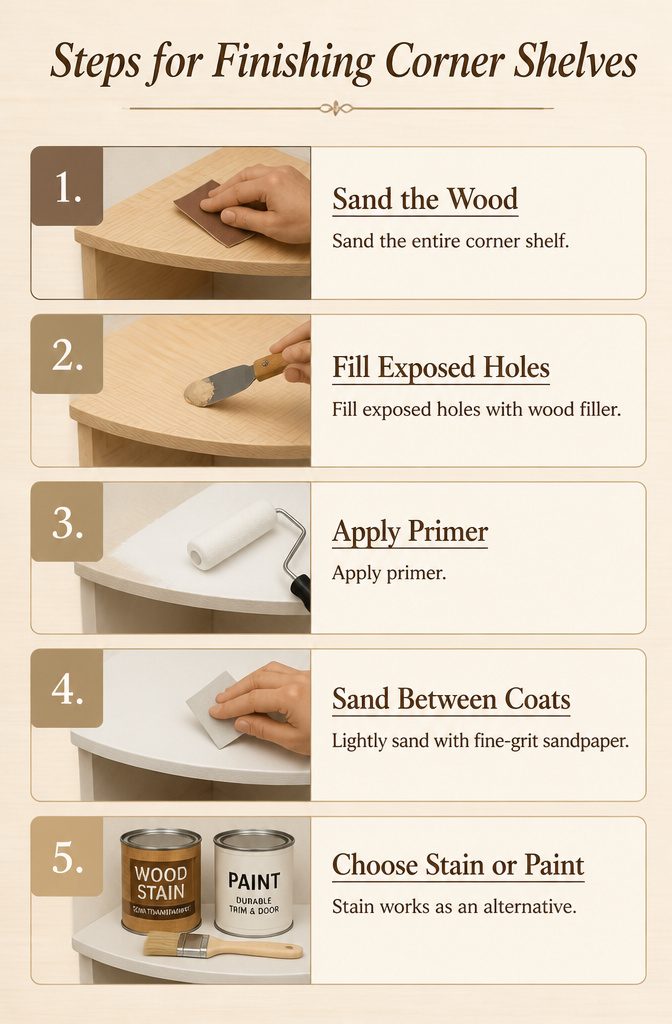
- Sand the entire corner shelf in the direction of the wood grain with medium-grit sandpaper, then remove the residue with a vacuum fitted with a soft-bristled brush followed by a damp, lint-free cloth. Let the wood dry completely.
- Fill exposed holes with wood filler, slightly overfilling each one; once dry, sand again and remove all residue before moving on.
- Apply primer, either as a separate coat or using paint with primer included. The first coat goes on with a quality synthetic-bristle brush or foam roller and must dry fully.
- Lightly sand with fine-grit sandpaper between coats, removing all residue each time. Two coats of paint is the minimum; three for any surface hands will touch regularly. High-use projects call for durable trim or door paint.
- Stain works as an alternative, but softwoods like pine need extra prep to take it evenly. Semi-transparent stain shows the grain; opaque products read more like paint. Follow the can’s directions for coats, drying time, and curing time exactly.
Dimensions and Pricing
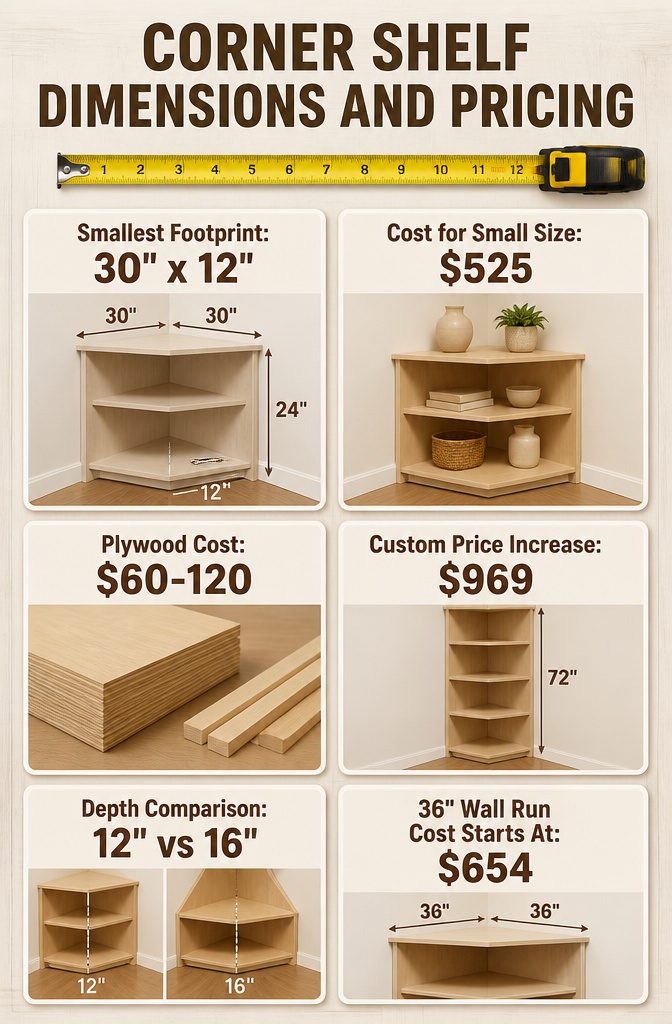
A 30" run along each wall, 24" high, 12" deep is the smallest footprint that still feels like real storage, and the custom benchmark lands at $525 for that exact size.
The same footprint in plywood and poplar trim costs roughly $60–120 at a big-box store, depending on whether you already own a saw.
The gap is real, and no one breaks it down: labor, markup, finishing, and delivery eat the other $400, but the proportions stay opaque.
Scaling up tells the same story.
A 30" base stretched to 72" high with one fixed and three adjustable shelves pushes the custom price to $969; the material difference is maybe one extra sheet of plywood and a few board feet of face-frame stock.
A 36" wall run with 16" depth instead of 12" starts at $654 for the shortest version, so the jump is not linear.
The deeper box eats more floor space than most renters can spare, which makes the 30" x 12" configuration the practical ceiling for small corners unless you own the wall and can build in.
What the Sources Call Custom
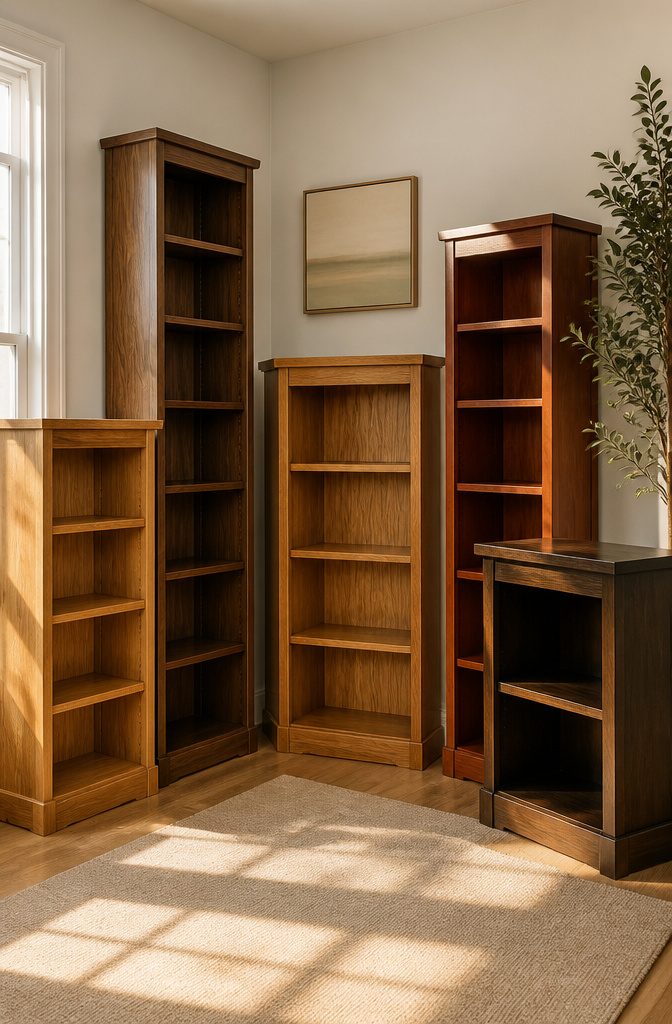
The word custom shifts meaning depending on where you look, and that shift costs money or time if you miss it.
Arthur Brown’s corner bookcases are listed as custom because you pick from set sizes and finishes.
The AWB Corner End Bookcase runs from 16 inches wide by 30 inches high at $358 up to 16 inches wide by 96 inches high at $910, with the AWB Corner Bookcase line adding 30-inch and 36-inch wall-run options topping out at $1,282.
You are not designing from scratch; you are configuring within a grid. That keeps the price predictable and the lead time short.
DIY plans use the same word differently. One builder measured each shelf level as he worked, trimming front edges with solid wood and fitting vertical spacers at the ends and center to account for width differences from bottom to top.
That custom means cutting to whatever your corner actually measures, which saves the cost of a made-to-order unit but costs you a weekend and the risk of a shelf that sags later.
The two paths share a word and little else.
If you are comparing prices, check whether custom means choose-your-size or cut-to-fit-your-wall. The first is a menu; the second is a project.
How I Read a Cut List
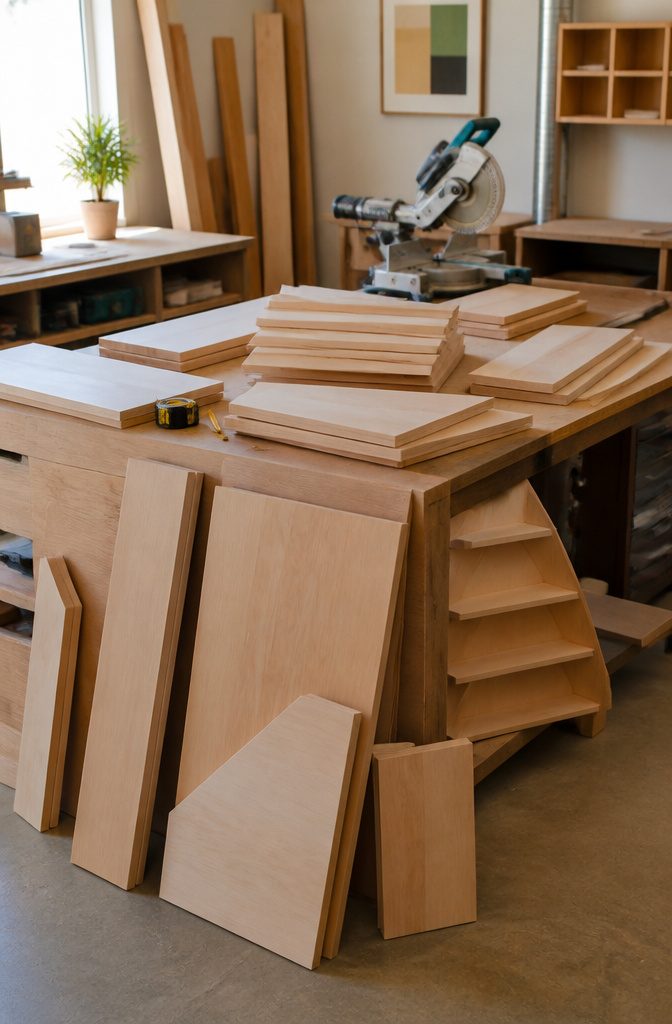
A cut list like the one for this corner unit looks straightforward until the saw is running.
Four side panels at 26-1/2 inches, two tops at 32-3/4 inches, and suddenly the math does not match the stack on the bench. Fractions appear because nominal lumber, the 1×12 or 2×2 called out at the store, is sold rough.
The actual width of a 1×12 is closer to 11-1/4 inches, which is why the trim pieces in the same list hit that odd figure.
The cut length stays fractional so the finished shelf lands square without forcing a round number that leaves a gap.
Setting the fence is where the kerf matters. The blade itself eats an eighth of an inch, sometimes a hair more on a thick stack.
Cut exactly to the 26-1/2 inch mark and the piece shrinks with every pass. I set the fence so the blade trims the waste side, not the keeper side, and I account for the kerf in the first test cut.
The common mistake is measuring twice, cutting once, and still ending up short because the second measurement ignored the blade.
The back panels in this plan, 27 inches by 19 inches and 27 inches by 31-2/4 inches, are forgiving since they get buried in the frame. The visible trim is not.
Renters and Corner Shelving
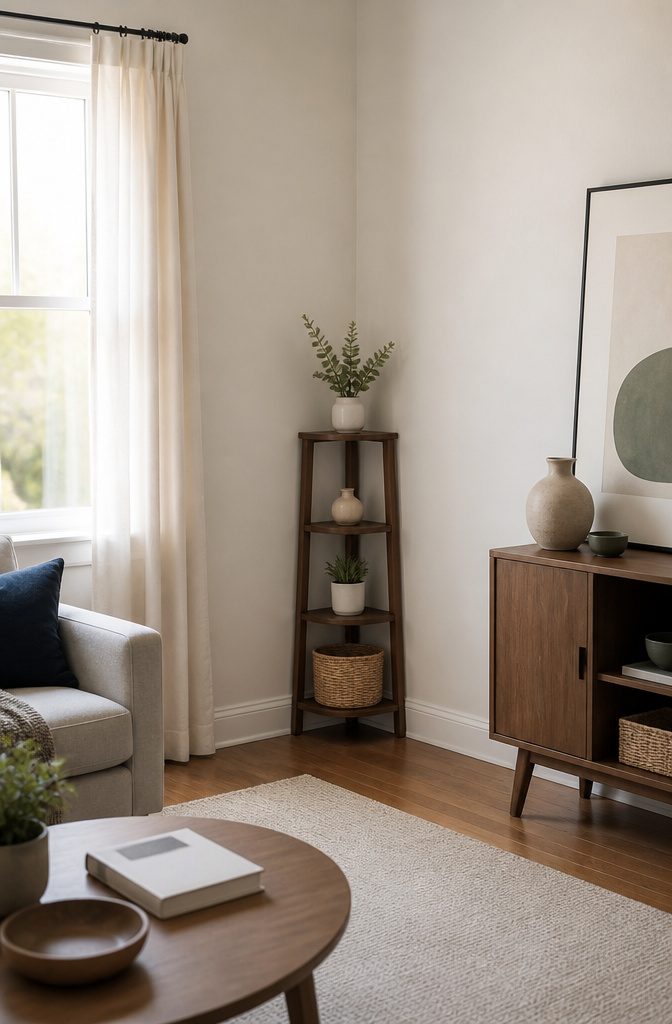
Built-ins are out if your lease says anything about "fixtures" or "alterations to walls," which most do. Freestanding corner units and corner-end bookcases are what you actually get to keep.
The Arthur W. Brown corner end bookcase runs 12 inches wide by 24 inches high for $297, and at 12 inches deep it sits flush enough to not dominate a small rental room.
Taller units go up to 96 inches, but anything past 48 inches needs a wall strap or furniture anchor rated for tip resistance.
Command strips won’t cut it for a loaded bookcase; look for tension-mounted poles or adhesive systems rated for the unit’s weight, and check that your lease doesn’t ban even "non-damaging" fasteners.
The $525 custom corner bookcase I priced earlier ships as a single piece you carry out the door. That portability is the real feature when your security deposit is on the line.
When I Skip the Fancy Finish
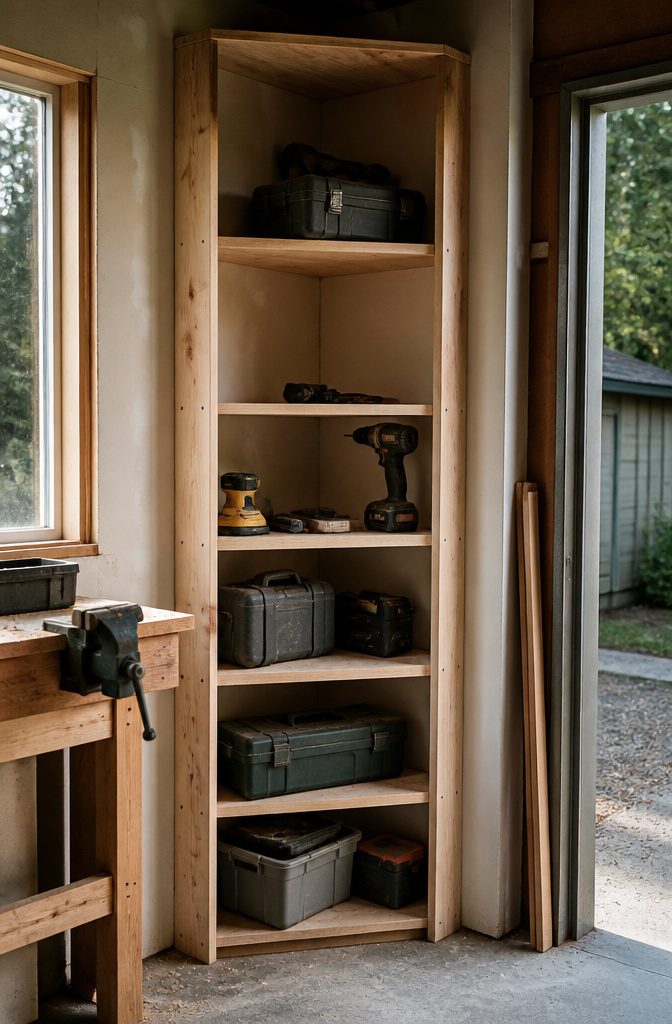
Bare pine with a single coat of poly lives in my garage corner shelf and I do not apologize for it. Sawdust still catches in the grain, but the unit holds oil filters and camping gear without complaint.
That same standard in the living room corner, where guests actually pause to look, would read as unfinished rather than honest. The mistake is not laziness; it is applying garage logic to a room that asks for more.
Sand to 220, prime, paint, and only then decide if you want the wood grain back through a tinted topcoat.
I skipped primer once on a living room corner unit because the pine looked clean enough. Six months later, knots bled through the paint like coffee stains on a shirt.
The shelf worked fine. I saw those knots every time I walked past.
Match the finish to the room’s traffic and the eye it gets, not to some universal rule of what counts as "done."
Frequently Asked Questions
What are the best materials for a corner bookshelf?
Furniture-grade plywood and solid wood are the standard combination for durability and a finished look. The Arthur Brown units use 3/4-inch plywood for the box and shelves with 3/4-inch solid wood face frames, which sits well above particleboard flat-pack quality.
For a DIY build, 1×12 boards work for shelves, 2x2s for legs and frame, and 1/4-inch plywood for back panels.
How do I build a corner bookshelf?
Start with a cut list that names every board length before you buy anything, like two 1×12 boards at 26-1/2 inches for side panels.
A miter saw handles the angled corner cuts, and you batch identical cuts together to save setup time.
Build two rectangular cases and butt them together for a boxed-in corner, or build in place one shelf at a time for an open corner with continuous shelves.
What is the price range for corner bookshelves?
Ready-made corner bookcases run from $297 for a 12-inch wide corner end unit up to $1,282 for a 96-inch tall custom unit with a 30-inch wall run.
A DIY build in the same 30-by-24-by-12-inch footprint costs roughly $60–120 in lumber, with the gap covering labor, markup, finishing, and delivery on the pre-built side. The 30-by-12-inch configuration is the practical ceiling for most small spaces.