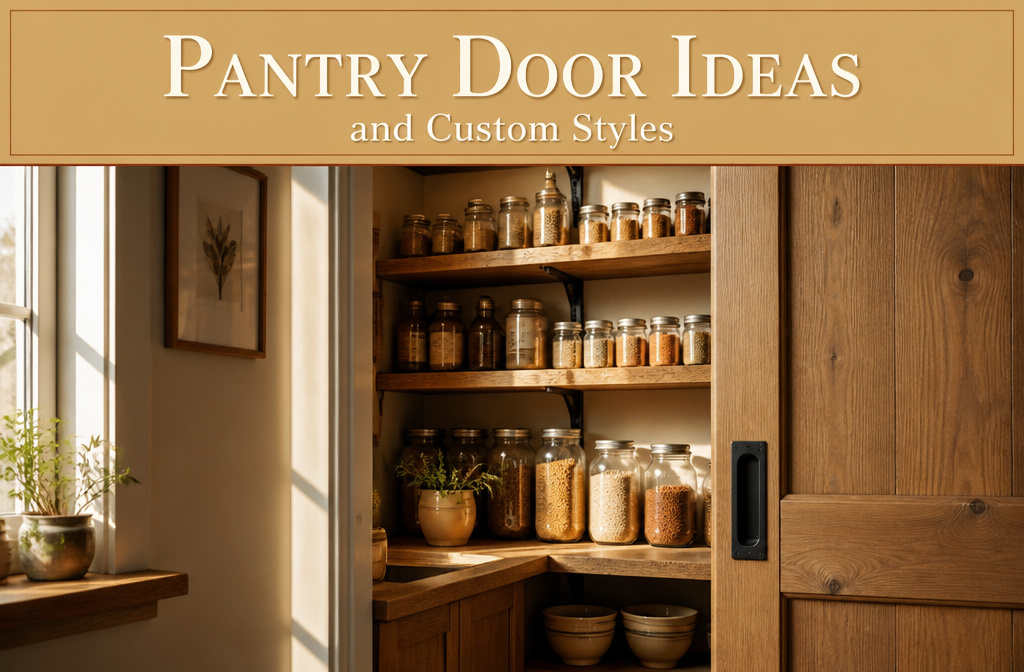
Doors for a pantry do more than hide cereal boxes.
The right style borrows daylight, saves floor space, or disappears into the wall entirely, but each gain carries a trade: a barn door needs twice its width in clear wall, while a pocket door demands deep framing and a non-load-bearing partition.
A solid wood panel from Simpson’s interior line, running Douglas Fir to Knotty Alder, starts around $28 per square foot and carries a ten-year warranty against the traffic a working pantry sees daily.
Classic Wood Panel Pantry Doors
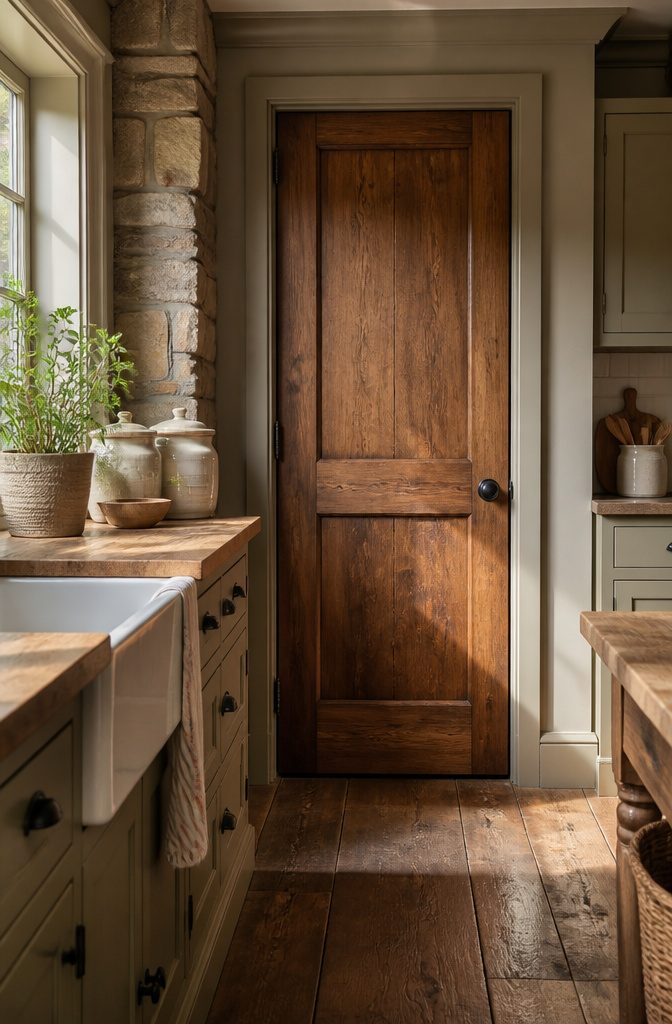
Solid wood panel doors carry a warmth that laminate never quite matches, and the grain holds its own against daily traffic.
You can stain them to blend with existing cabinetry, paint them for a clean break, or leave the grain bare where a kitchen already runs busy.
That flexibility matters in older homes where floors and cabinets never came from the same decade.
Farmhouse, craftsman, and even stripped-down modern kitchens all read the same door differently, which is why this style refuses to date itself.
A ten-year limited warranty from manufacturers like Simpson backs the claim that these doors are built for actual use, not just showroom appeal.
Their interior line runs from Douglas Fir to Ponderosa Pine and Knotty Alder, so the material choice becomes a budget decision as much as an aesthetic one.
Factory finishing is available now on some models, which saves a weekend of masking and sanding if the timeline matters more than the hands-on control.
Elegant Frosted Glass Pantry Doors
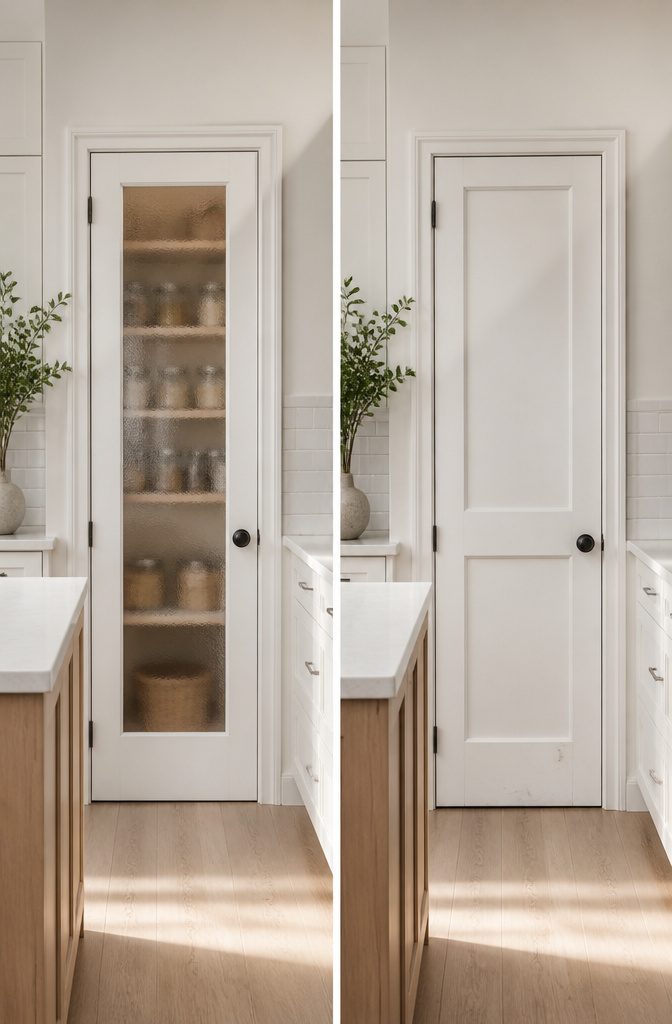
Frosted glass pantry doors let daylight into a windowless pantry without putting every mismatched cereal box on display. The glass diffuses what comes through, so the space feels lit from within rather than boxed off.
Clear glass is the other option if you keep the shelves styled and want that visibility, but frosted is the safer default for most households where a pantry is a working storage space, not a showroom.
Half-frosted configurations split the difference: clear glass above, frosted below. The upper panel borrows light and keeps some openness at eye level, while the lower panel hides the clutter that collects at waist height and below.
This is the version I would order for a kitchen that faces the main living area, where the pantry door stays in sightline during dinner.
The frosting itself can be simple and smooth or carry a sandblasted pattern. Geometric motifs read more modern; floral etchings lean traditional.
Either way, the privacy level is adjustable from light frosting to full coverage. A heavily frosted panel still transmits daylight, just without any readable silhouette behind it.
Glass inserts framed in wood are worth considering if the door gets hard use; the structure handles impact better than a full glass panel, and the look suits kitchens with warmer cabinetry.
Single doors work under about 30 inches of opening width; double doors need more room but give full access to walk-in shelving.
Decorative Glass with Patterns
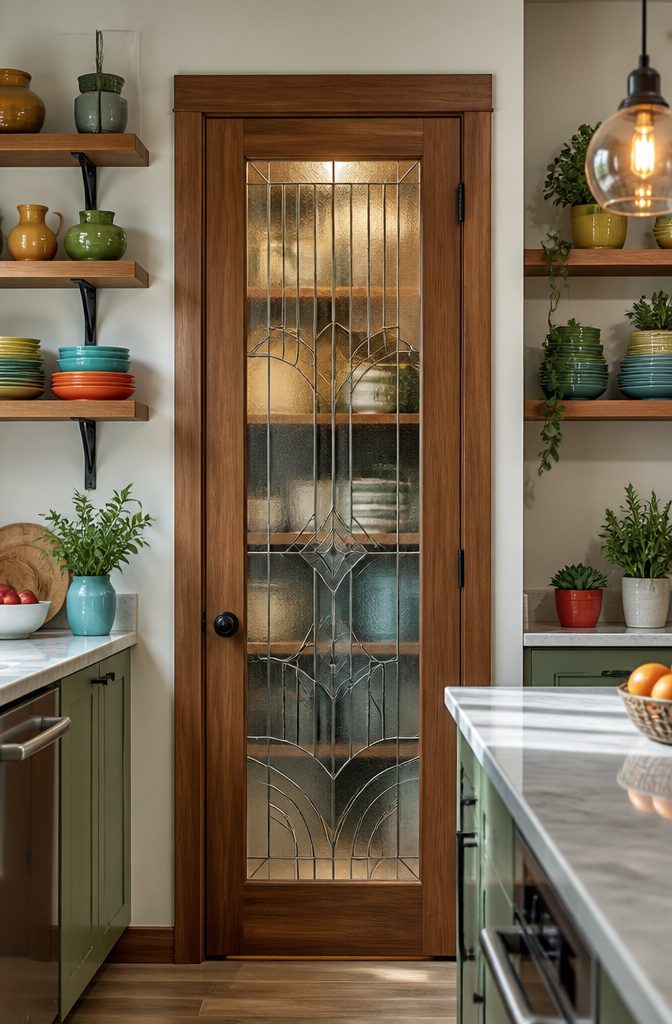
Patterned glass turns the pantry door into something you actually notice walking through the kitchen.
Where frosted glass stays quiet and uniform, a geometric or floral etching catches light differently from every angle and gives the door a reason to exist beyond hiding cereal boxes.
I spent time comparing the two when I was reading up on pantry options, and the gap is bigger than I expected: frosted reads as a functional screen, but patterned glass reads as cabinetry with a story.
The carved depth matters more than I thought. 3D sandblasted designs with hand-painted accents create actual shading, not just surface texture, so the pattern shifts as you move past it.
Ribbed glass sits somewhere between the two camps, slightly see-through but distorted enough that guests get shape without detail. That middle ground works if your pantry inventory changes daily and you do not want to stage shelves for company.
What sold me on patterned glass over plain frosted was the artistic freedom without giving up the practical job.
You still get light through the door, still get enough obscurity that mismatched storage containers disappear, but you also get a design element that ties into cabinet hardware or backsplash tile.
Custom etching runs higher than off-the-shelf frosted panels, which is the trade for one-of-a-kind work. For renters, the workaround is a patterned film applied to existing glass, swapped out at move-out.
Sliding Barn-Style Pantry Doors
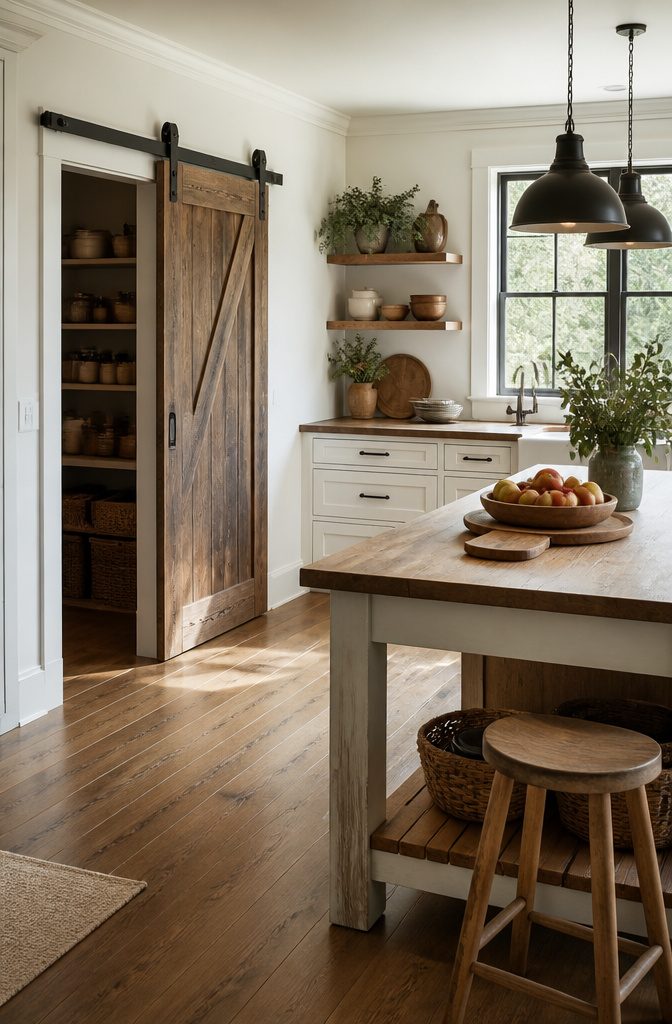
A barn door on a pantry eats up wall space instead of floor space, which matters when your kitchen opens straight into the living area.
The door slides along an exposed track, so you need roughly the width of the opening clear on one side.
That track hardware and a solid wood slab ran me about $1,270 installed, which sits at the upper end of what I’d spend on a weekend project but still inside a real budget.
Rustic wood planks give you the farmhouse look that still reads warm in 2026, though the heft can darken a small kitchen. Swapping in glass panels, either clear or frosted, keeps the same sliding function while letting light through.
One detail I watch for: the track needs mounting into studs or a header board, because a pantry door gets opened hard and often. Skip that step and the rail loosens inside six months.
Modern Frameless Glass Designs
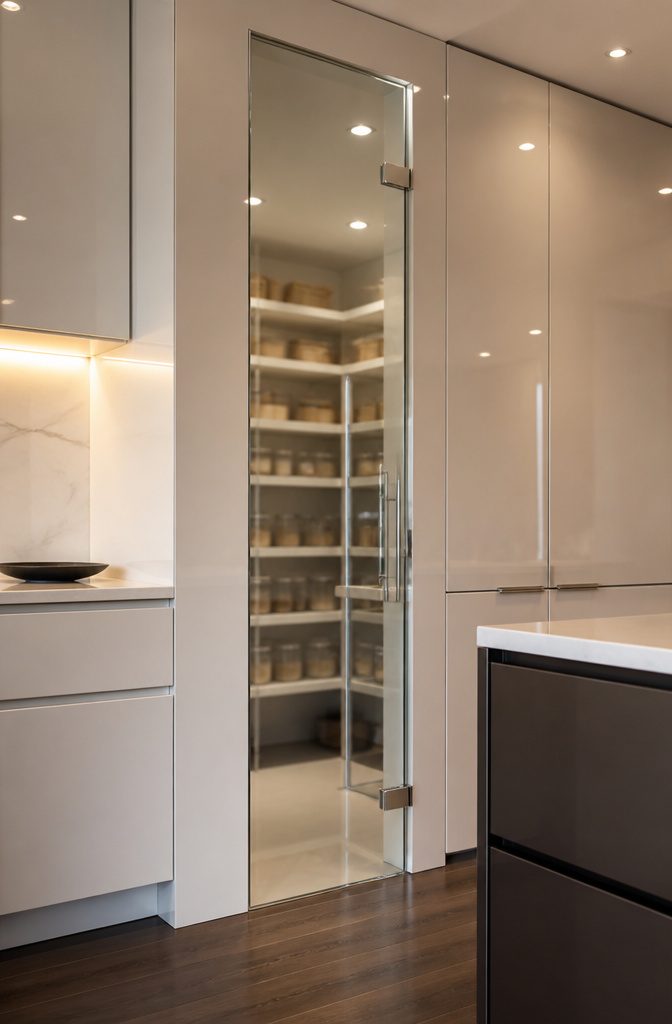
Frameless glass pantry doors strip away the molding and hardware that frame traditional styles so the glass itself does the visual work.
Clear or lightly frosted panels keep sightlines open, which matters in smaller kitchens where a framed door can feel like another wall. Etched details, when they appear, stay subtle; nothing competes with the minimal look.
The difference from framed options is the integration. A framed glass door reads as a separate piece of furniture.
Frameless designs sit flush against contemporary cabinetry and handle-less drawers, continuing the plane rather than interrupting it. For wider openings, double frameless units carry the same clean profile across the span without adding visual weight.
The risk is maintenance. Fingerprints and cooking residue show immediately on unframed glass, and there is no molding to hide edge chips if a bag or cart catches the corner.
Frosted finishes hide smudges better than clear, but they also block the light that makes frameless appealing in the first place.
In my own searching, the kitchens where this style succeeds are the ones that already committed to minimalism everywhere else; dropping one frameless door into a traditional kitchen reads as an accident, not a choice.
French-Inspired Pantry Doors
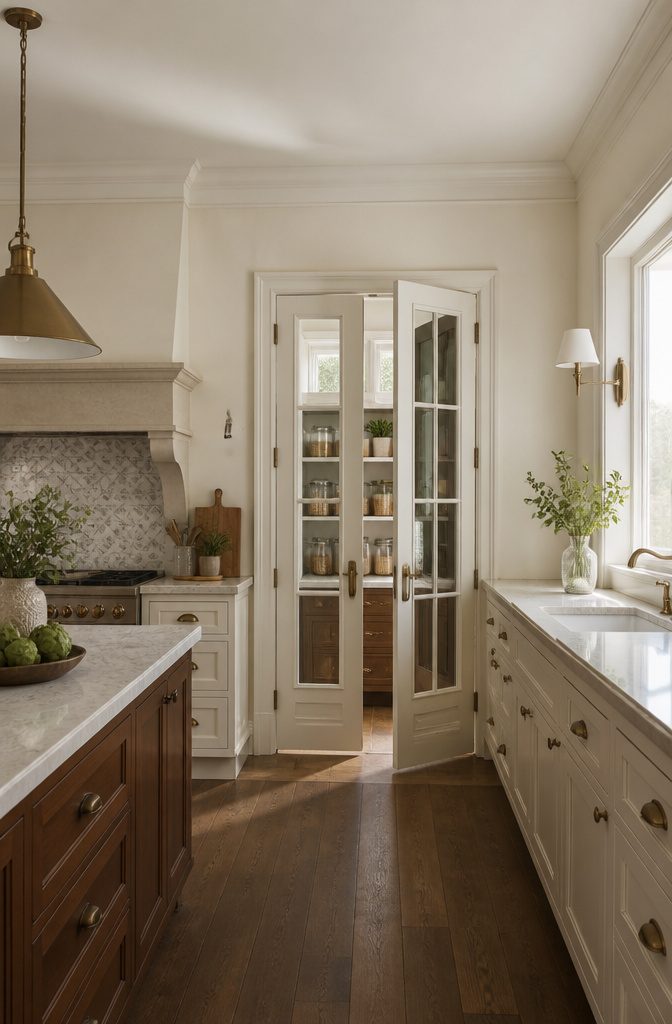
French-inspired pantry doors with glass inserts carry a symmetry that turns a storage opening into a proper feature.
The divided panes, whether simple grids or more ornate patterns, let light pass through so the pantry reads as its own room rather than a dark box. That openness matters in kitchens where every wall counts.
The catch is the swing.
Double doors need clearance on both sides, and in a tight galley kitchen that footprint can interrupt the work triangle. Single French pantry doors fit narrower openings and keep the same look without the real estate.
For wider pass-throughs, double-action swinging doors solve the traffic problem: they push both ways, no handle required, which keeps hands free when you’re carrying a sheet-pan dinner or a stack of groceries.
These doors suit transitional and farmhouse kitchens especially well, where the goal is to elevate the pantry from utility to design element without drifting into showcase territory.
The muntins add texture without noise, and the glass keeps sightlines open so the space feels larger than it is.
Pantry Doors with Custom Text or Graphics
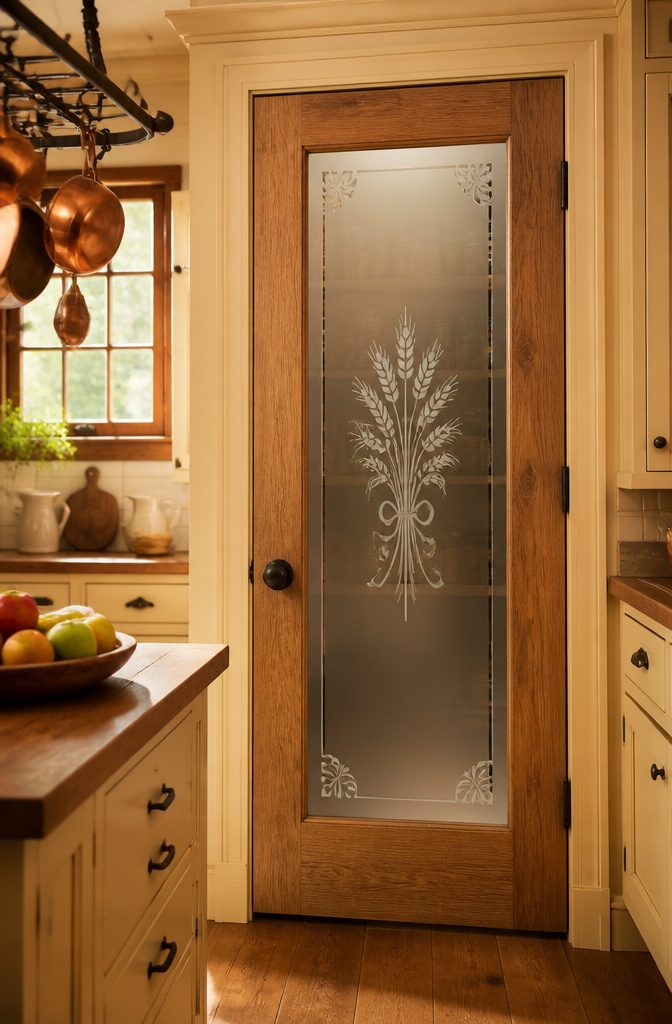
Etched glass turns a basic pantry door into something that actually belongs in the kitchen.
The word "Pantry" cut right into the panel, maybe with a simple border or a font that matches the cabinets, reads as intentional design instead of afterthought.
Some homeowners push further with wheat stalks or fruit scrollwork; the graphic labels the space and gives guests something to notice besides a blank slab.
Painted or applied graphics work on solid doors too. A chalkboard panel on barn-track hardware lets the door carry the weekly grocery list or a dinner menu, which is useful in a kitchen where counter space already goes fast.
A hand-painted sign or a contrasting color on a farmhouse-style frame achieves the same focal-point effect without the glass.
What separates the successful custom door from the busy one is restraint.
One graphic element, maybe two if they share a scale, and the door holds together. Add a border, a motif, a sign, and a chalk strip, and the eye has nowhere to land.
The etched or painted "Pantry" label alone usually wins, especially in a small kitchen where the door sits close to other visual noise.
Frosted glass with a single etched motif also hides the clutter inside while still reading as decoration, not just a privacy fix.
Matching the wood species to existing cabinets, which most manufacturers offer, keeps the custom element from looking like a transplant from another room. The door becomes a design feature because it coordinates, not because it shouts.
Rustic Distressed Finishes
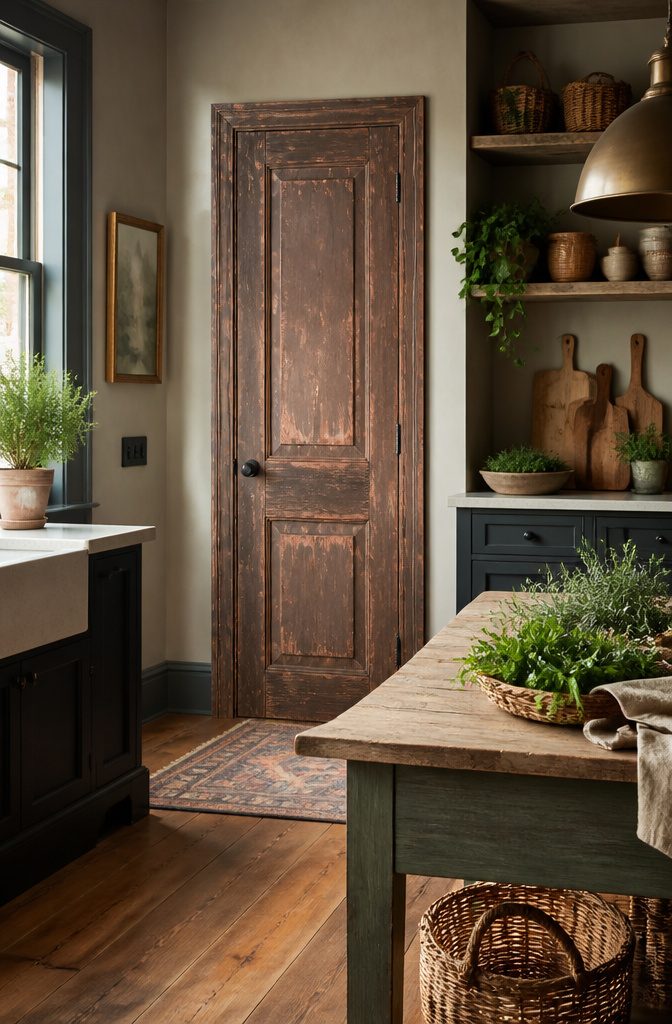
Distressed wood on a pantry door delivers a different effect than a sliding barn door made from the same rough material. The barn door is about the hardware, the track, the way it moves.
A distressed finish keeps the door stationary and puts all the attention on the surface: the nicks, the worn edges, the color that looks like it faded over decades rather than weeks.
Reclaimed or weathered wood gives a kitchen the kind of warmth that reads as earned rather than staged.
It does not pass light the way glass panels do, so it works best when the pantry sits against an interior wall or when you do not need to borrow daylight from an adjoining room.
Kaitlyn Murphy of Marguerite Rodgers Interior Design sources antique doors specifically for this texture and patina, noting that they rescue an otherwise plain, utilitarian opening from looking like an afterthought.
The vintage effect sits right at home in farmhouse or country kitchens, but it also softens a space that has gone too sleek with new cabinets and polished countertops.
The risk is overdoing the theme: one heavily worn door is character; a kitchen full of matching distressed pieces starts to feel like a set.
I would pair it with simple hardware, iron or unlacquered brass, and let the wood be the one ornate thing in view.
Bi-Fold Pantry Doors
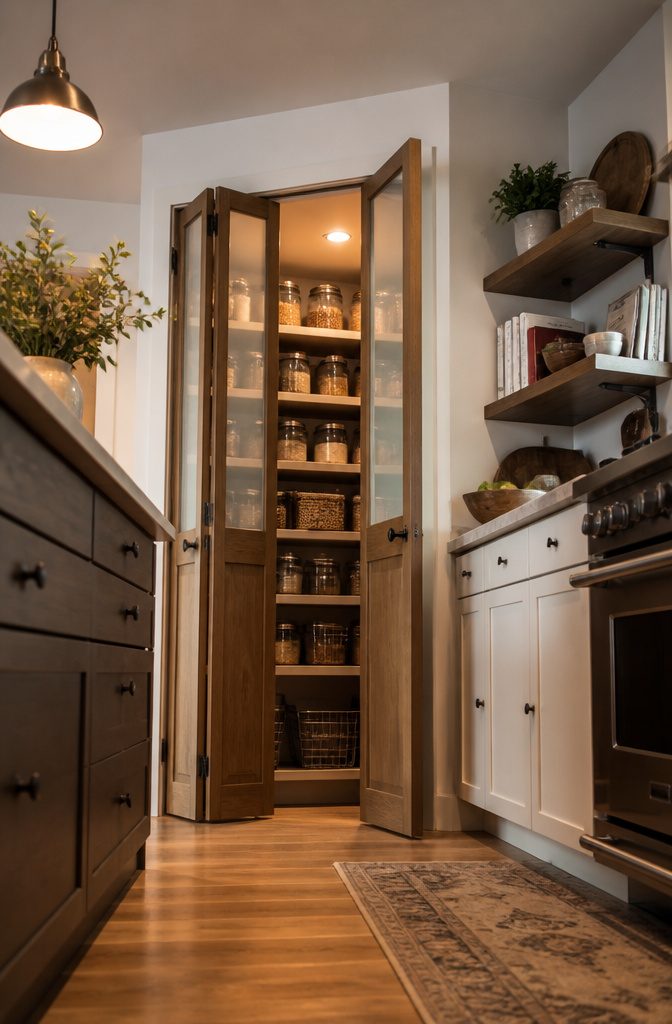
Bi-fold pantry doors fold back on themselves rather than swinging clear into the room, which makes them the practical pick when a standard door would crowd a tight kitchen or block a high-traffic aisle.
Two hinged panels connect and travel along a top track, stacking to one side of the frame so you keep the floor space that a swing door would claim.
Solid wood gives a traditional, substantial feel, while panels with glass inserts lighten the look and let you spot what is inside before you unfold anything.
That combination of compact function and styling options is why bi-fold designs have stayed in use for decades.
They work especially well in rental situations where you cannot restructure the opening itself but still need the door to disappear as much as a door can.
Pocket Pantry Doors
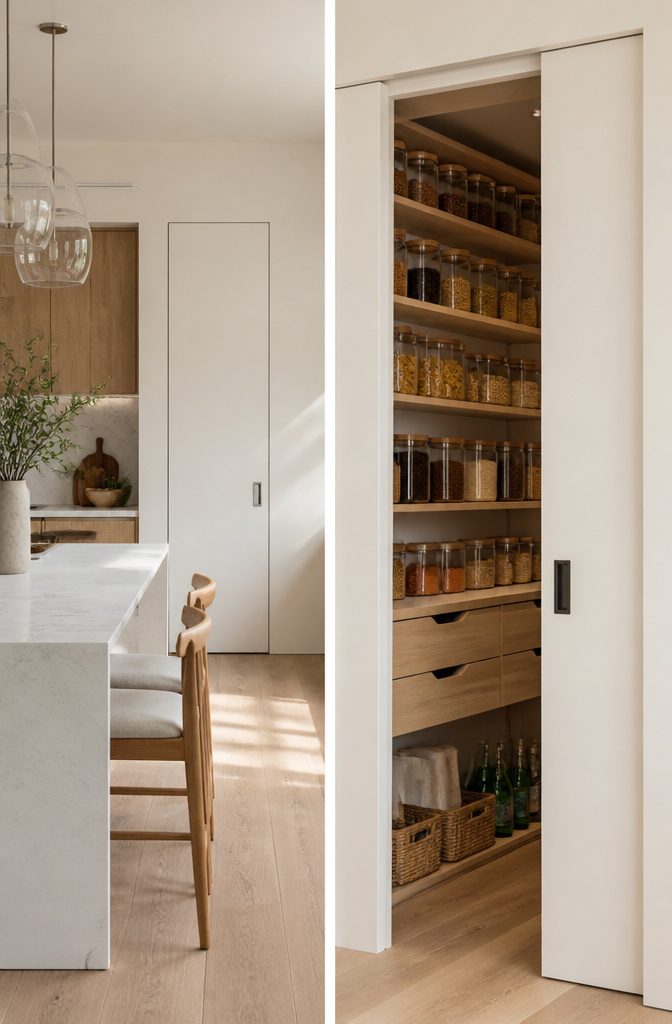
Pocket pantry doors slide straight into the wall cavity and disappear completely when open, which is why they earn their reputation as the most thorough space-saver among sliding options.
The walkway stays clear, the door stays out of sight, and you still get full access to the pantry.
That disappearance act comes at a cost though: the wall needs enough depth to accept the door, and the framing has to be built for it from the start.
I looked into these for a 6-by-6 foot kitchen corner where a swinging door would have blocked the only path to the back door. The contractor’s first question was whether the wall was load-bearing.
In an interior partition, you’re often looking at reframing one side to create the pocket. Surface-mounted barn or bypass hardware skips all of that.
The finish options run from simple wood to modern glass to custom etched designs, so the style range is wide.
Solid-core wood resists warping over time, and if you go with glass, professionally etched panels hold up better than film or spray alternatives that can peel or fade.
The hardware matters too: a pocket door lives inside the wall, so fixing a derailed track later means cutting drywall.
Hidden Pantry Doors
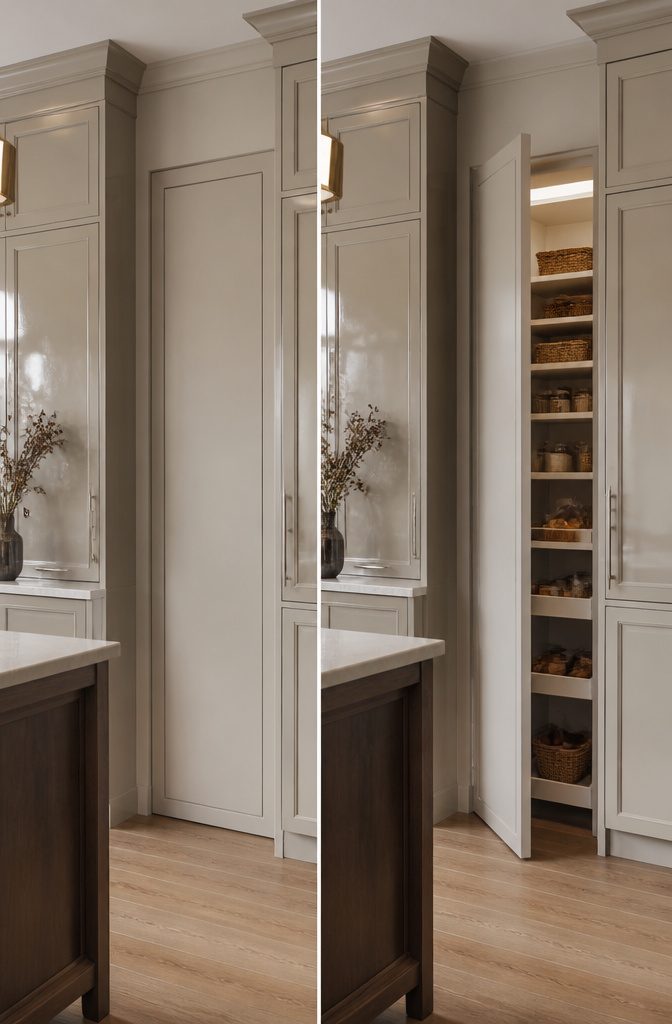
A hidden pantry door reads as part of the room itself: a wall panel or stretch of cabinetry that happens to swing open. The effect breaks down the moment standard surface-mounted hinges interrupt the flush plane.
Concealed hinges recess fully into the door edge and frame so no hardware shows when the door is closed, and that clean edge is what sells the illusion.
The panel finish has to match the surrounding surface exactly, or the eye catches the seam.
Door thickness, hinge selection, and panel finish all need coordination before anything gets ordered, not after the pieces arrive. This is a niche path among doors for a pantry, and it costs more in planning than in materials.
A decorative French door wants to be seen; this one wants to disappear. For a renter, the permanent hardware and precise fitting make it a project to skip unless you own the place and plan to stay.
For a homeowner building out a kitchen wall, the payoff is storage that does not read as storage at all.
Antique Pantry Doors
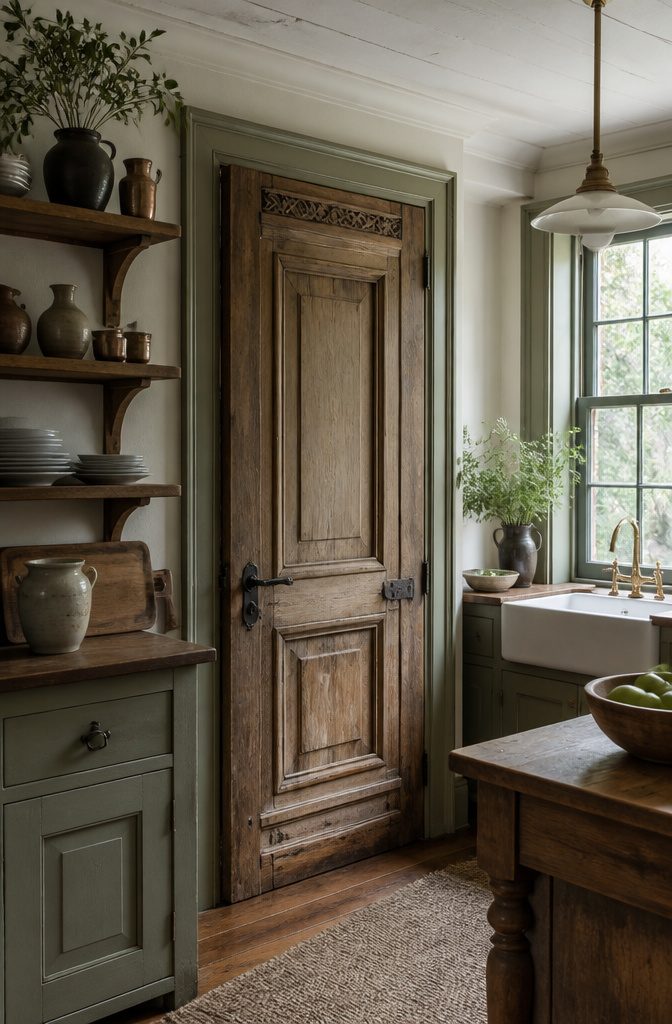
Antique doors for a pantry carry the kind of texture and patina that factory-made panels rarely match.
Kaitlyn Murphy of Marguerite Rodgers Interior Design sources them specifically for pantries and powder rooms, where their painted or carved surfaces turn an ordinary utilitarian space into something with a backstory.
The hunt itself is half the work, since sizing, swing direction, and frame thickness all have to line up with your existing opening. A door that is too narrow leaves gaps; one too thick binds against the jamb.
Salvage yards and architectural dealers price these by condition and rarity, so the same carved Victorian panel might cost three times what a plain painted door from the same era runs.
For renters or anyone on a weekend timeline, this is probably not the practical path. The payoff comes for homeowners who can wait for the right piece and build the frame to fit it, not the other way around.
What to Know About Custom Sizing
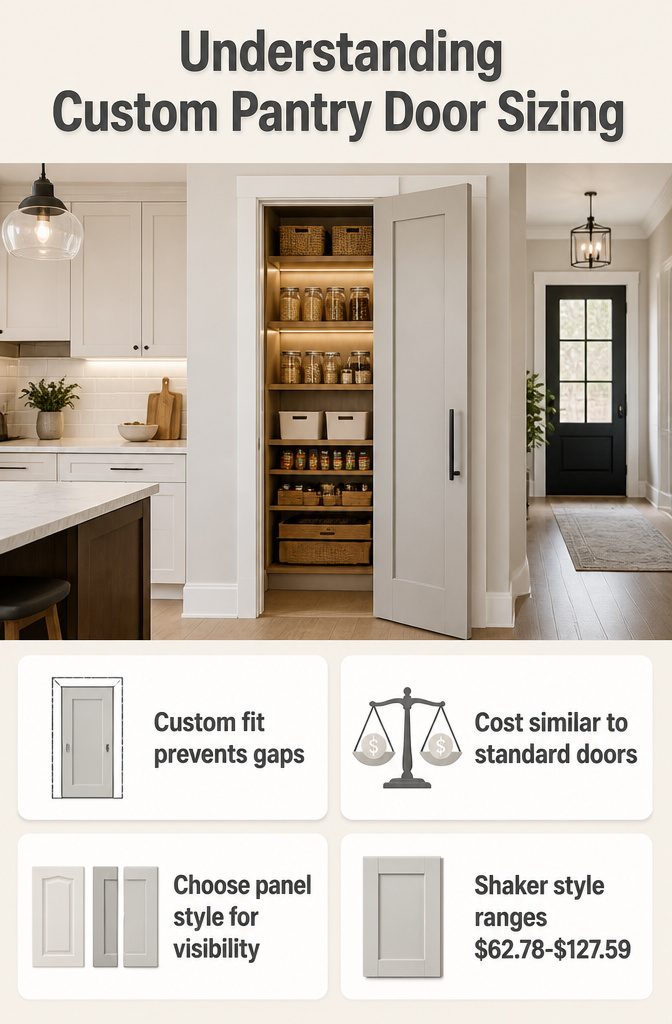
Stock doors rarely fit a pantry opening on the first try, especially in older kitchens where the framing has settled or a previous owner widened the closet.
What convinced me, reading through a dozen of these builds, is that custom sizing costs about the same as forcing a standard door to work with extra trim and filler strips.
Most makers build to your exact opening width and height, so the door sits flush without shimming gaps.
The same order usually lets you pick the panel style. Shaker remains the default for kitchens right now, running about $62.78–$127.59 per square foot depending on whether you go with a Valu-Line classic or a framed variation.
Raised panel reads more traditional, flat panel reads cleaner and more modern, and both are priced in the same bands.
If your pantry sits right off the entry hall where guests see it, the panel choice matters more than the hardware; if it is tucked behind the refrigerator, a simple flat slab at $28.12 per square foot spends the money where you actually live.
Matching the Door to Your Kitchen
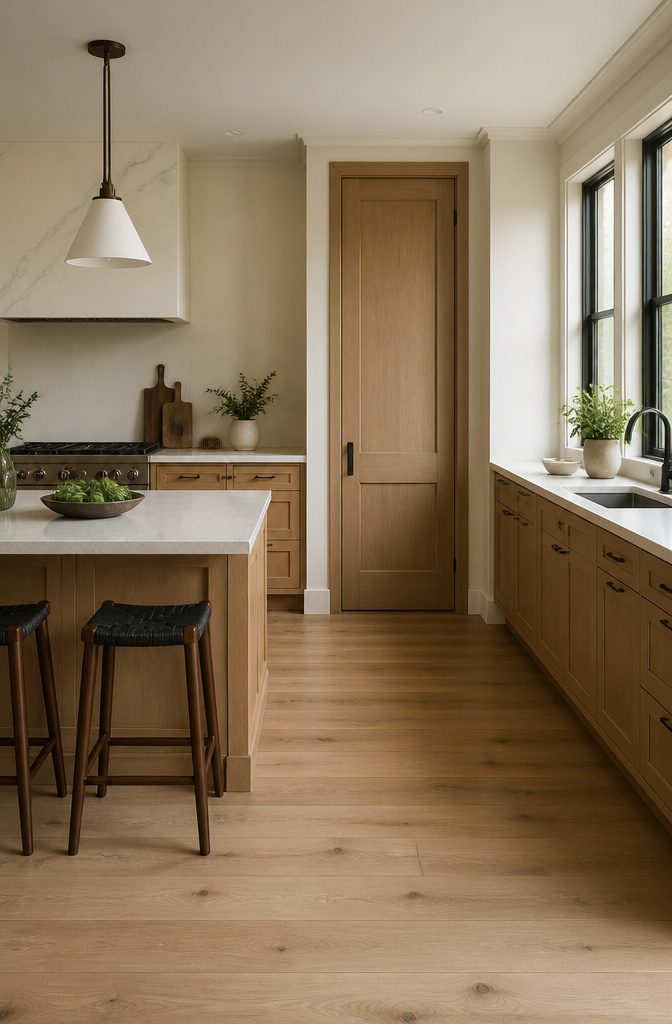
The door you choose should finish the kitchen, not fight it.
In my own place, the cabinets are a warm white oak, and swapping the builder-grade hollow core for a matching Simpson 4941 in White Oak made the pantry read as built-in rather than an afterthought.
Match the finish to your cabinets or flooring, not both, or the door starts looking like a sample board.
Small kitchens need the door to do quiet work. A sliding barn track or pocket style keeps the swing radius clear, which matters when you are working with a 6-foot galley and two people trying to make coffee at once.
Larger kitchens can carry something that announces itself: double doors, glass panels, hardware that differs from the rest of the room by a deliberate notch.
Privacy is the other half of the equation. Frosted glass passes light without displaying the cereal boxes, and in a kitchen that only gets morning sun, that transmission matters more than the look.
Hidden doors, flush to the wall plane with no visible hinges, work best when the pantry sits along a run of cabinetry you want uninterrupted.
They are a different goal than the decorative route, not a better one. The choice depends on whether your kitchen needs the pantry to disappear or to speak up.
Space-Saving Design Decisions
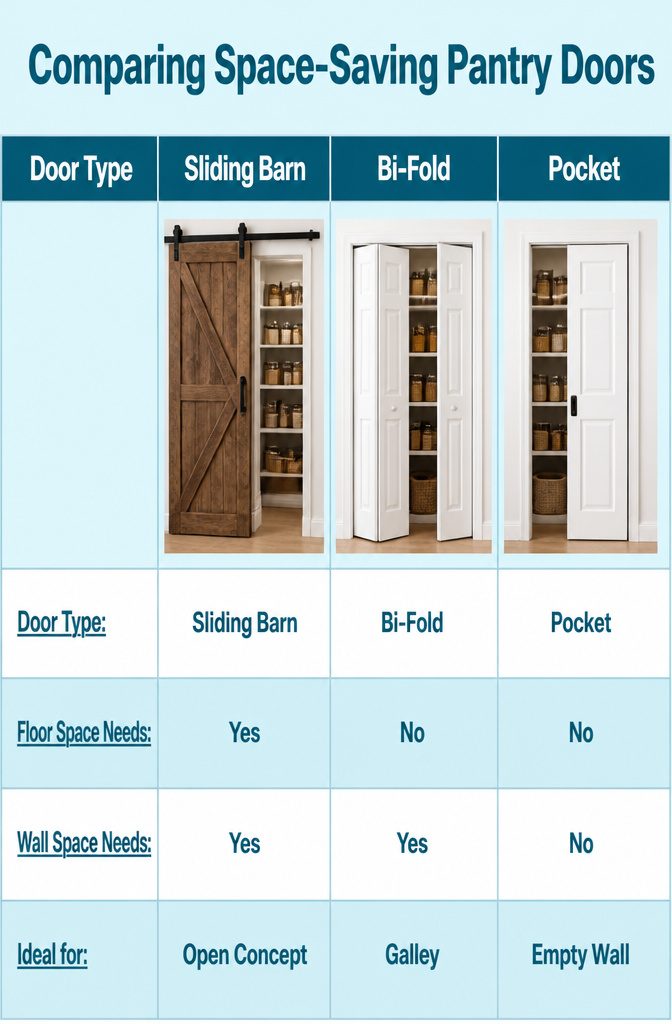
Tight pantry spaces force a real choice between three door types, and the wrong one costs you either floor space or wall space you needed for something else.
Sliding barn doors keep the floor clear but eat wall space on one or both sides of the opening.
They work best when the pantry sits against a wall with no cabinetry, no doorway, and no light switch in the path of the track.
In an open-concept kitchen, that exposed hardware becomes part of the look, rustic wood or glass inserts turning the door itself into a focal point.
Budget for at least twice the door width in clear wall, or the barn door blocks something else you use daily.
Bi-fold doors fold in on themselves, so they need clearance only in front of the pantry opening, not to either side.
The panels stack about four to six inches deep when open, which matters in a narrow galley kitchen where every sideways inch counts.
They handle solid wood or glass inserts without the structural demands of a track system, and they are the easier retrofit if you are keeping an existing frame.
Pocket doors recess fully into the wall, so they vanish when open and need no floor or wall clearance at all.
That sounds ideal, but the wall itself must be deep enough to swallow the door slab, and any plumbing or electrical in that wall has to move.
Custom millwork can make a pocket door into something worth looking at, yet the installation is invasive enough that renters should cross it off the list unless the landlord is already renovating.
If you own and the wall is empty, the pocket door wins for pure function.
Renters or anyone with built-ins on every adjacent wall should measure their available wall length first, then decide between barn or bi-fold based on what that number allows.
Frequently Asked Questions
What are the best materials for pantry doors?
Solid wood and professionally etched glass are the most durable choices for doors for a pantry. Hardwood frames resist warping over years of use, while sandblasted glass panels won’t peel or fade like film or spray alternatives.
Glass inserts framed in wood handle impact better than full glass panels, and solid-core construction matters for pocket styles that live inside the wall.
How can I customize my pantry door?
You can order custom sizing to your exact opening width and height, choose panel styles like Shaker or raised, and add etched text or graphics.
Factory finishing is available on some wood models, and most makers let you match the wood species to existing cabinetry.
Etched glass with the word "Pantry," decorative borders, or motifs like wheat stalks turn the door into a design feature rather than a blank slab.
What styles of pantry doors are popular?
Classic wood panel, frosted glass, sliding barn, and French-inspired doors lead the list for 2026.
Wood panels suit farmhouse through modern kitchens and carry a ten-year limited warranty from manufacturers like Simpson. Frosted glass borrows light without showing clutter.
Barn doors save floor space by sliding along an exposed track. French doors with divided panes and double-action swinging function add symmetry and hands-free passage.